What Muse can do for stock research
Meta's Muse is a personal agent powered by the Muse Spark model, designed to execute multi-step tasks within its own cloud virtual machine. It operates across a standalone application, the web, and WhatsApp, providing flexible access for investors.
The agent can delegate various research errands, such as pulling the latest 10-Q filings and summarizing segment numbers. It can also build and maintain a watchlist tracker, delivering recurring pre-earnings briefs directly to WhatsApp.
Muse can compile peer tables and track specific financial metrics over time. However, it does not directly interact with brokerage accounts or facilitate stock purchases, focusing solely on information retrieval and analysis. Users must verify all reported numbers independently.
- Launched: September 8, 2026
- Model: Muse Spark
- Access: Standalone app, web, WhatsApp
- Pricing: Free tier, $20/month, $100/month
- Core Function: Multi-step task execution on cloud VM
The exact prompt we used
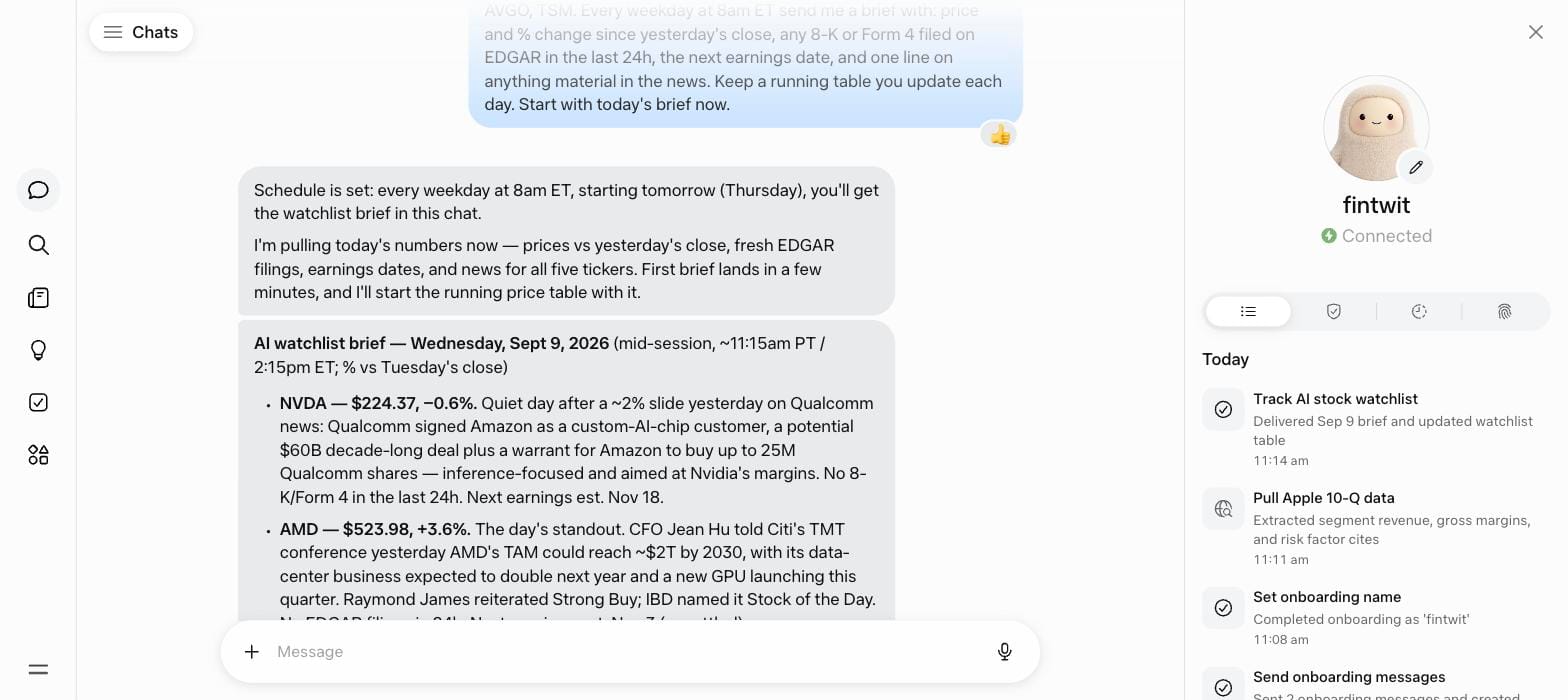
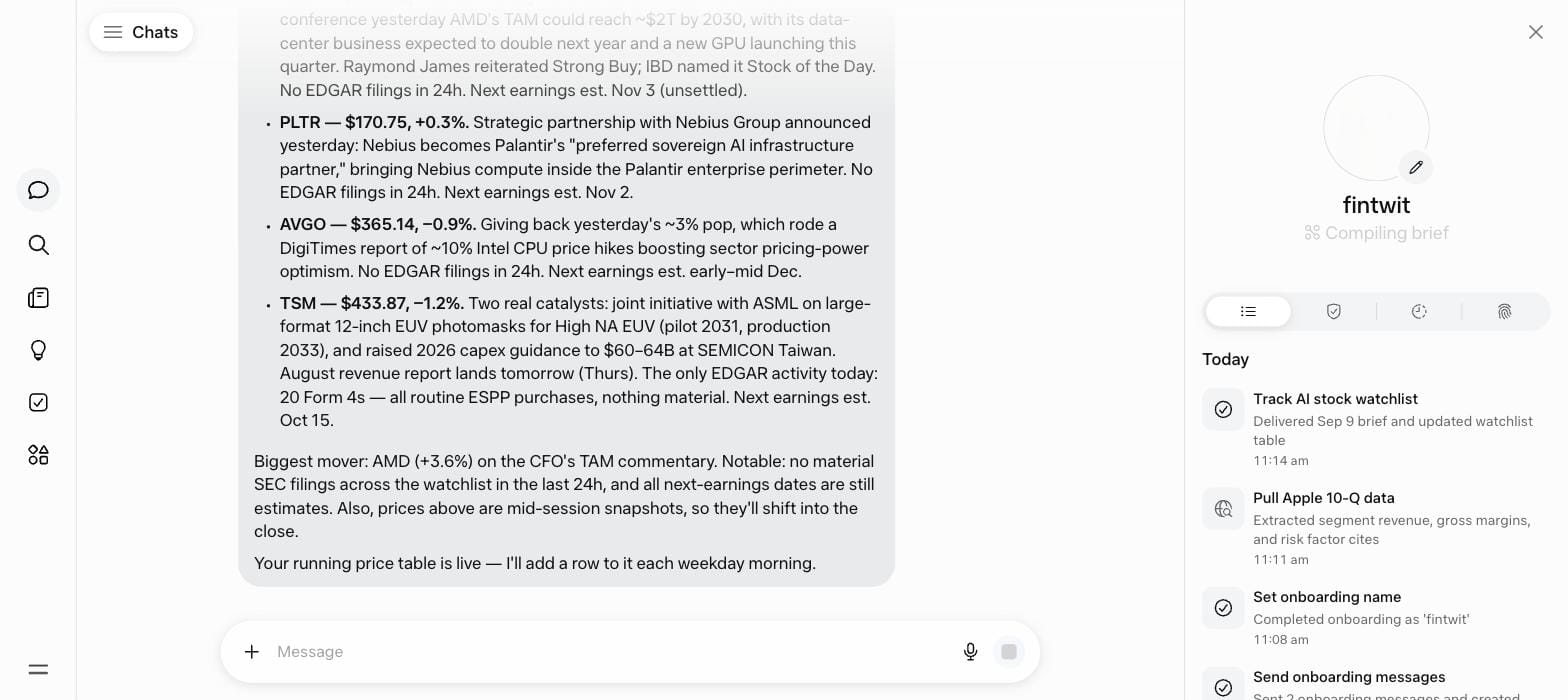
The prompt below was used to generate the screenshots in this post, tracking AI stock watchlist tickers NVDA, AMD, PLTR, AVGO, and TSM. You can paste this prompt directly into Muse to replicate the daily brief and running table.
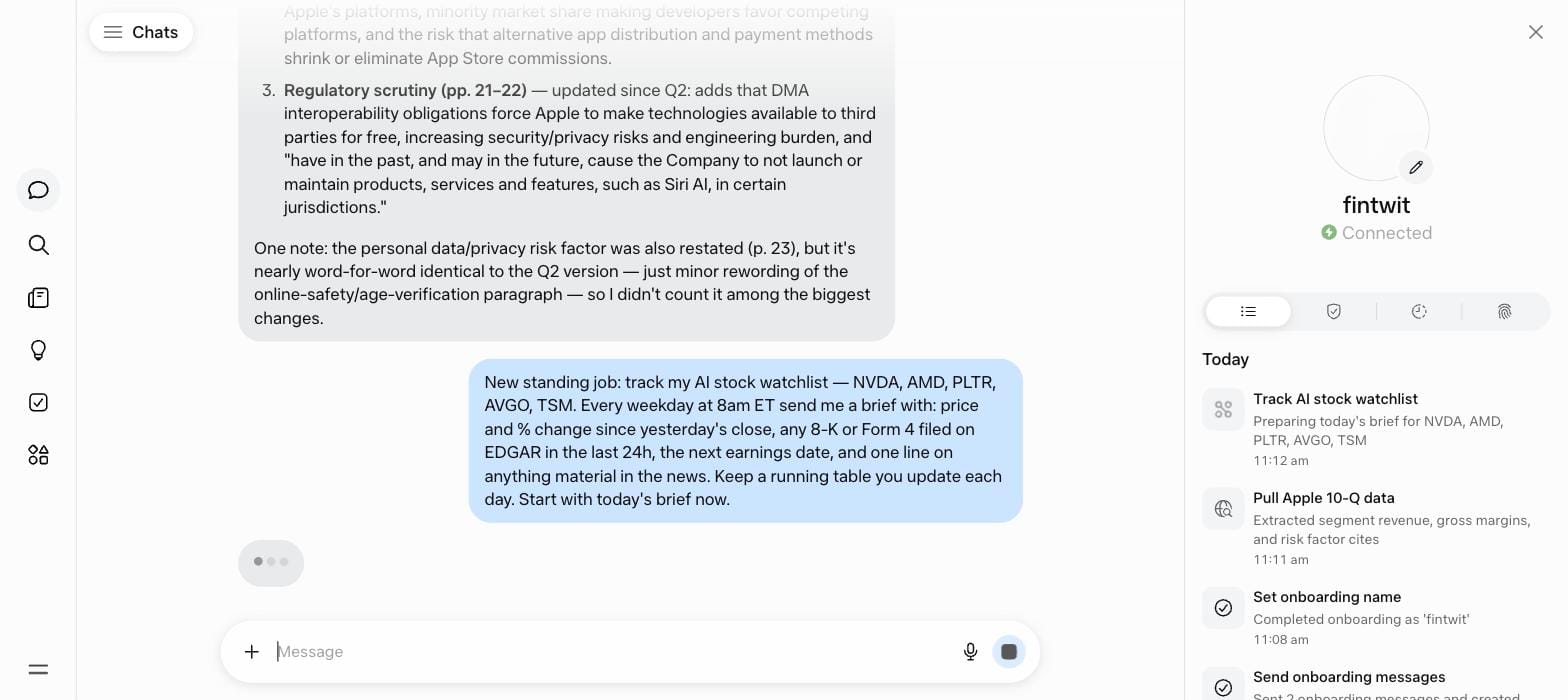
New standing job: track my AI stock watchlist — NVDA, AMD, PLTR, AVGO, TSM. Every weekday at 8am ET send me a brief with: price and % change since yesterday's close, any 8-K or Form 4 filed on EDGAR in the last 24h, the next earnings date, and one line on anything material in the news. Keep a running table you update each day. Start with today's brief now.
10 more Muse prompts for stock research
Muse's ability to handle complex, multi-step instructions makes it a powerful tool for automating routine research. The following prompts illustrate additional ways to leverage Muse for in-depth stock analysis, from summarizing financial reports to tracking insider activity.
Summarize Latest 10-Q Segments
Muse, access the latest 10-Q filing for NVIDIA (NVDA) from the SEC EDGAR database. Navigate to the 'Segment Information' section within the financial statements. Extract and summarize the key revenue and operating income figures for each reported segment for the most recent quarter and year-to-date periods. Present this summary in a concise, bulleted list, highlighting any significant year-over-year changes. Deliver the output to me via the Muse standalone app.
Build & Maintain Watchlist Tracker
Muse, create a new stock watchlist tracker for the following tickers: AMD, PLTR, AVGO, TSM. For each stock, track its current price, 52-week high/low, market capitalization, and P/E ratio. Update this data daily at 9:00 AM EST. If any stock moves +/- 5% from its previous day's close, send an alert to my WhatsApp. Maintain this tracker in a Google Sheet accessible via my linked Google Drive account, updating it automatically.
Recurring Pre-Earnings Briefs
Muse, for NVIDIA (NVDA), AMD, and PLTR, set up a recurring task to generate a pre-earnings brief. Two days before each company's scheduled earnings release, compile a summary of analyst consensus estimates for revenue and EPS, recent news headlines related to the company, and any significant insider trading activity reported in the last 90 days. Deliver this brief to my WhatsApp by 5:00 PM EST on the designated day.
Compile Peer Comparison Table
Muse, compile a peer comparison table for NVIDIA (NVDA). Identify its primary competitors in the AI chip sector. For NVDA and its top three competitors, gather the following metrics: current market cap, trailing 12-month revenue, net income, P/E ratio, and gross profit margin. Present this data in a clear, sortable table format. Include the source URL for each data point for verification. Deliver the table to my email address associated with my Muse account.
Monitor News for [Company]
Muse, continuously monitor major financial news outlets and press releases for [Company Name] (e.g., TSM). If any news breaks regarding significant new product launches, major partnerships, regulatory investigations, or changes in executive leadership, immediately send a brief summary of the news and a link to the source article to my WhatsApp. Prioritize news from reputable financial media.
Explain [Financial Term]
Muse, explain the concept of 'free cash flow yield' in simple terms, suitable for a retail investor. Provide a formula for its calculation and explain why it is considered an important metric for evaluating a company's financial health. Give an example of how it might be applied to a real company like AVGO. Deliver this explanation as a concise paragraph within the Muse app.
Summarize Analyst Ratings for [Ticker]
Muse, find and summarize the latest analyst ratings and price targets for PLTR from at least three different reputable financial institutions (e.g., Morningstar, Zacks, S&P Global). Note the current consensus rating (Buy, Hold, Sell) and the average price target. Highlight any significant upgrades or downgrades in the last 30 days. Present this information in a structured format within the Muse web interface.
Track SEC Filings for [Ticker]
Muse, set up a monitoring task to alert me whenever a new 8-K or 424B filing is released by AMD. When a new filing is detected, provide a brief, high-level summary of the filing's purpose and key contents, along with a direct link to the SEC document. Deliver these alerts to my email. Ensure this task runs continuously.
Research Industry Trends for [Sector]
Muse, research and summarize the top three emerging technology trends impacting the semiconductor industry over the next 12-18 months. Focus on areas like AI integration, advanced packaging, and supply chain resilience. For each trend, provide a brief explanation and identify one or two companies (e.g., TSM, NVDA) that are particularly well-positioned or vulnerable. Present this as a short report in the Muse app.
Verify Financial Data for [Company]
Muse, I need to verify the reported Q3 2026 revenue figure for NVIDIA (NVDA). Access their official Q3 2026 earnings release or 10-Q filing. Extract the exact reported revenue number and the corresponding period. Cross-reference this with data from a reputable financial data provider like Bloomberg or Refinitiv (if accessible). Report the verified number and the source URLs to me in the Muse app, noting any discrepancies if found.
Muse vs Fintwit Chat
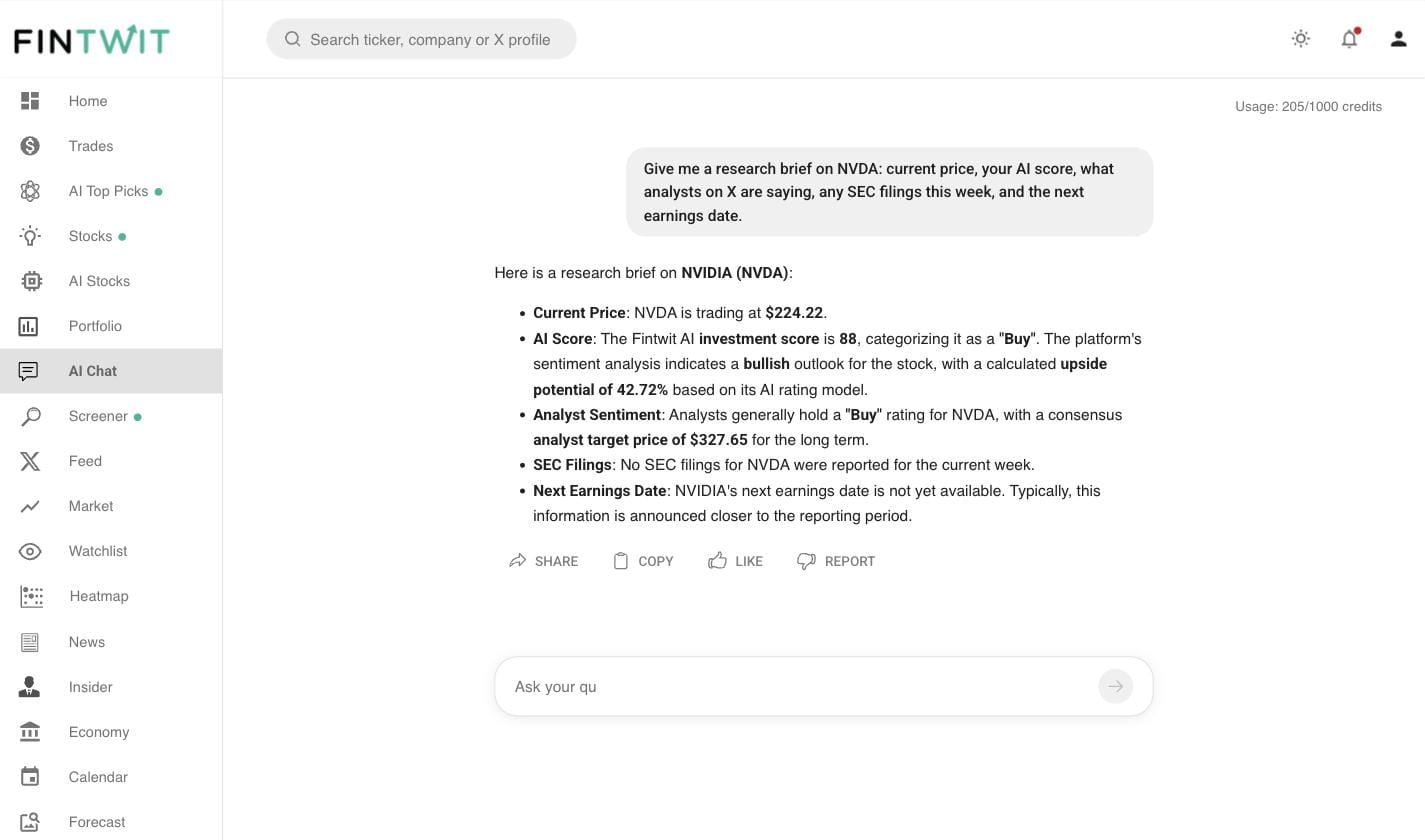
While Muse requires a written prompt and minutes of run time, Fintwit Chat provides instant, pre-computed data for the same tickers. Fintwit's built-in AI chat (fintwit.ai/chat) delivers live price data and proprietary scores without any prompt engineering.
Stanford researchers found that an 'AI analyst' could generate $17.1 million per quarter in returns, significantly outperforming human managers at $2.8 million per quarter. This highlights the potential for AI tools to enhance investment decision-making.
- Muse requires a paid tier for advanced features.
- Muse needs a specific written prompt for each task.
- Muse tasks can take minutes to run on its cloud VM.
- Fintwit Chat returns live price data instantly.
- Fintwit Chat provides Fintwit's AI score and analyst signals from X.
- Fintwit Chat includes filings and earnings dates in one answer.
| Feature | Muse ($20/mo) | Fintwit ($9/mo) |
|---|---|---|
| Real-time market data | No | Yes — live prices & signals |
| AI stock analysis | Manual prompts required | Automatic for any stock |
| AI portfolio health check | Not available | Built-in with recommendations |
| Curated AI stock picks | Not available | Daily AI top picks & ETFs |
| Stock screener | Not available | Full screener with filters |
| Trending stocks from X | Not available | Real-time signal extraction |
| Earnings & dividend calendar | Not available | Built-in calendars |
| Brokerage integration | Not available | Connect Robinhood, Schwab, etc. |
| Price | $20/mo | $9/mo |
Where Muse falls short
- Muse does not offer direct integration with brokerage accounts for trading.
- The agent cannot execute stock purchases or sales.
- All financial data reported by Muse requires manual verification by the user.
- Its analysis is limited to publicly available information, not proprietary data feeds.
- Complex, nuanced qualitative analysis may still require human interpretation.
Pro tips
- Always specify the exact date range for historical data requests to ensure accuracy.
- Use clear, unambiguous language in your prompts to avoid misinterpretations by the agent.
- Set up recurring tasks for watchlists and pre-earnings briefs to automate routine checks.
- Cross-reference Muse's reported numbers with official company filings (e.g., 10-K, 10-Q) for verification.
- Experiment with different prompt structures to find the most efficient way to extract desired information.