
The setup
Disney faces a complex narrative heading into the August 5 report. While the company has successfully transitioned its streaming business to profitability, investors are now shifting their focus toward margin sustainability and the impact of macroeconomic headwinds on theme park attendance.
Recent analyst actions reflect this cautious optimism. Firms including Jefferies and Citi have lowered price targets to $125 and $135 respectively, citing potential risks from broader consumer spending pressures despite the company's strong content pipeline.
- Jefferies maintains a Buy rating but cut its price target to $125 from $132.
- Citi holds a Buy rating with a reduced price target of $135.
- Benchmark reiterates a Buy rating, viewing the stock as undervalued at current levels.
- Management reaffirmed its fiscal 2026 outlook, including at least $8 billion in share repurchases.
Consensus numbers
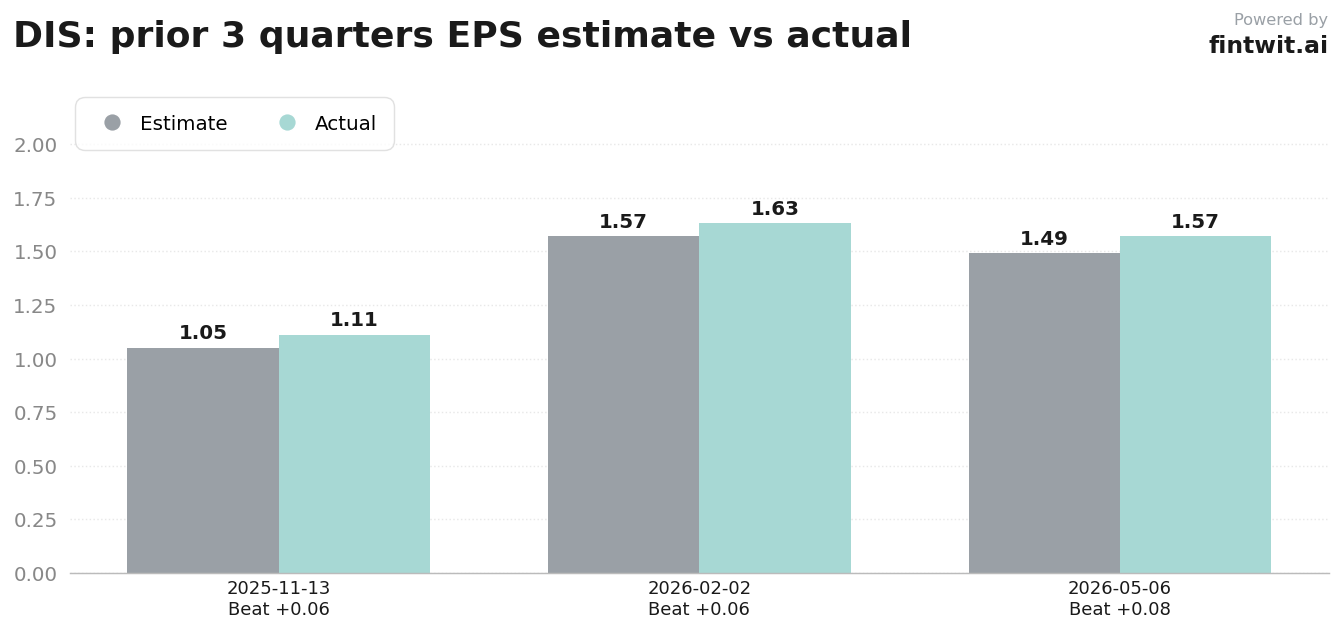
Wall Street expects Disney to report earnings per share of $1.89 on revenue of $25.39 billion for the third quarter. The company has demonstrated a consistent ability to outperform expectations, having beaten EPS estimates in each of the last three quarters.
The following data points summarize the current consensus and historical performance trends.
- Q3 2026 EPS Estimate: $1.89.
- Q3 2026 Revenue Estimate: $25.39 billion.
- Q2 2026 Actual EPS: $1.57 vs $1.49 estimate.
- Q1 2026 Actual EPS: $1.63 vs $1.57 estimate.
- Q4 2025 Actual EPS: $1.11 vs $1.05 estimate.
- Management guidance for Q3 segment operating income is approximately $5.3 billion.
What we'll watch on the call
The primary focus for investors will be the performance of the Experiences segment, specifically domestic park attendance. Analysts are looking for evidence that recent softening trends are temporary rather than a structural decline in consumer discretionary spending.
Streaming remains the digital centerpiece of the company's strategy. Management must demonstrate that the current profitability is sustainable and that subscriber churn is being effectively managed in a competitive landscape.
The Sports segment, anchored by ESPN, is also under scrutiny. Management has already signaled an expected 14% decline in operating income for this division due to rising programming rights costs.
- Can domestic park attendance recover from recent softening trends?
- What is the long-term strategy for sustaining streaming margin expansion?
- How will the company offset the 14% operating income decline in the Sports segment?
- Are macroeconomic uncertainties significantly altering consumer spending patterns at resorts?
Fintwit's AI verdict
The market sentiment surrounding Disney remains polarized as the company navigates the transition from pure growth to sustained profitability. While the valuation appears attractive to some institutional observers, the near-term volatility in the parks division creates a distinct hurdle for the stock's immediate performance.
Investors are weighing the success of the streaming pivot against the cyclical risks inherent in the entertainment sector. The upcoming earnings call will serve as a critical litmus test for whether the company can maintain its 12% adjusted EPS growth target in a challenging macro environment.