The setup
Wall Street is closely monitoring Walmart's ability to maintain its defensive buffer through grocery dominance while managing the gap between revenue growth and operating income expansion. Analysts are scrutinizing whether the company can deliver the profit leverage promised in its previous guidance.
Macroeconomic headwinds remain a primary concern for investors. Persistent high gasoline prices are impacting consumer stock-up behavior, while uncertainty regarding potential tariff-driven cost increases continues to pressure margin outlooks.
- Management previously guided for Q2 adjusted EPS of $0.72 to $0.74.
- Constant-currency net sales growth is targeted at 4.0% to 5.0%.
- Constant-currency operating income growth is projected between 7.0% and 10.0%.
- Christopher Nardone of Bank of America Securities maintains a Buy rating with a $144 target, citing digital sales acceleration.
- Guggenheim analysts lowered their price target to $135, citing moderating food volumes.
Consensus numbers
The market expects Walmart to report revenue of $186.7 billion for the second quarter of fiscal 2027. This follows a history of consistent performance where the company has frequently exceeded analyst expectations.
Investors are looking for evidence that high-margin segments like e-commerce and advertising are continuing to scale. These areas are viewed as critical drivers for validating the company's current valuation.
- EPS Estimate: $0.741
- Revenue Estimate: $186.7 billion
- Walmart U.S. Comparable Sales: Expected growth range of 2.5% to 3.5%.
- E-commerce growth target: Sustained growth above 20%.
- Advertising business growth target: Sustained growth above 35%.
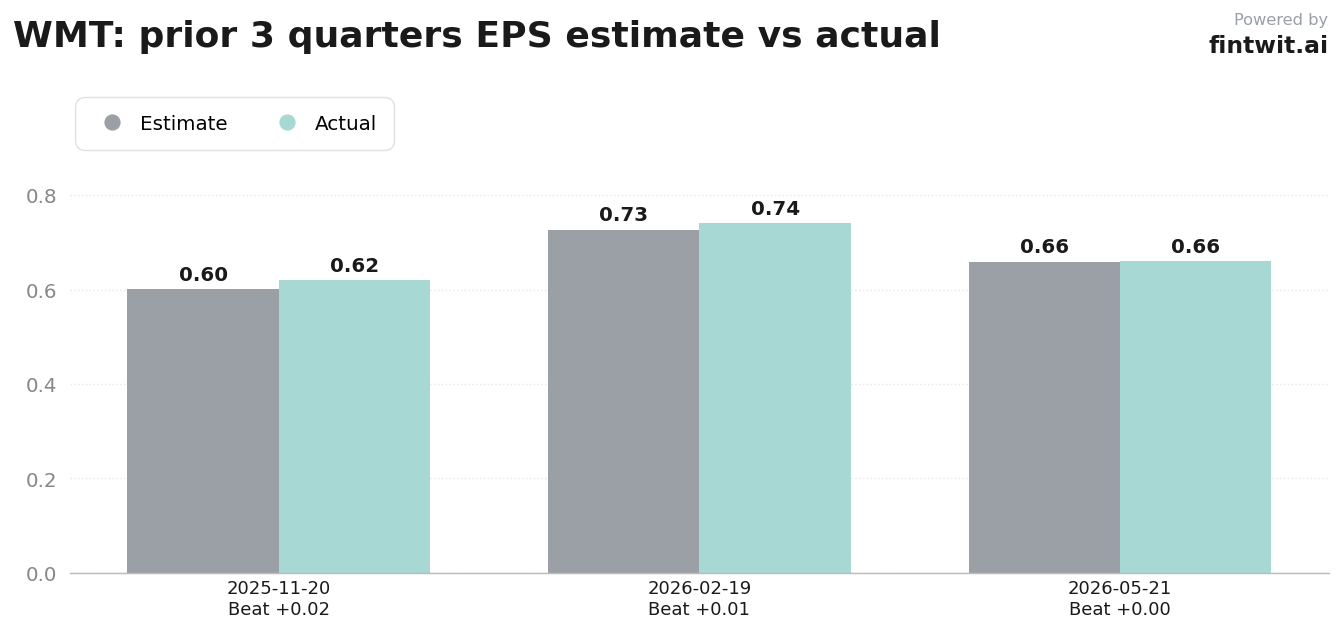
- Q1 2026 EPS: $0.66 vs $0.659 estimate.
- Q4 2026 EPS: $0.74 vs $0.727 estimate.
- Q3 2026 EPS: $0.62 vs $0.601 estimate.
What we'll watch on the call
The primary focus for the earnings call will be the health of the U.S. consumer and the sustainability of current spending patterns. Management's commentary on the back half of 2026 will be essential for determining if the current retail slowdown is temporary.
Operational efficiency remains a key theme. Analysts will look for specific details on how the company is managing tariff-driven cost increases and whether these are being passed through to shelf prices.
- Is the consumer cracking, or is recent retail weakness just gasoline optics?
- Can Walmart deliver operating income growth that outpaces revenue growth?
- How is the company managing the pass-through of tariff-driven cost increases to shelf prices?
- What is the outlook for the back half of 2026 regarding consumer discretionary spending?
- Will management raise full-year guidance or maintain the current outlook?
Fintwit's AI verdict
The analytical consensus points toward a resilient performance despite the broader retail sector's volatility. The combination of market share gains in grocery and the scaling of high-margin digital services creates a compelling narrative for long-term holders.
Investors should weigh the potential for a positive surprise against the risks of a conservative outlook for the remainder of the year. The upcoming report will serve as a definitive test of the company's ability to navigate current macro pressures.