The setup
Walmart is positioned as the primary bellwether for U.S. consumer health as it approaches its August 20, 2026, earnings release. The company previously guided for Q2 adjusted EPS of $0.72 to $0.74 and constant-currency net sales growth of 4.0% to 5.0%.
Investors are scrutinizing the gap between revenue growth and operating income expansion. The market seeks evidence that the company's digital flywheel—comprising e-commerce, advertising, and membership services—can drive profit leverage despite macroeconomic headwinds.
- Management guidance targets constant-currency operating income growth of 7.0% to 10.0%.
- Christopher Nardone of Bank of America Securities expects a return to a beat-and-raise cycle.
- Guggenheim analysts lowered their price target to $135, citing moderating food volumes.
- Persistent high gasoline prices remain a primary factor in consumer discretionary budget allocation.
Consensus numbers
Wall Street consensus estimates for the second quarter reflect steady growth despite a challenging retail backdrop. The company has consistently outperformed revenue estimates over the last three quarters.
The following figures represent the current market expectations for the upcoming report.
- EPS Estimate: $0.741
- Revenue Estimate: $186.7 billion
- Year-over-year revenue growth expectation: 8.8%
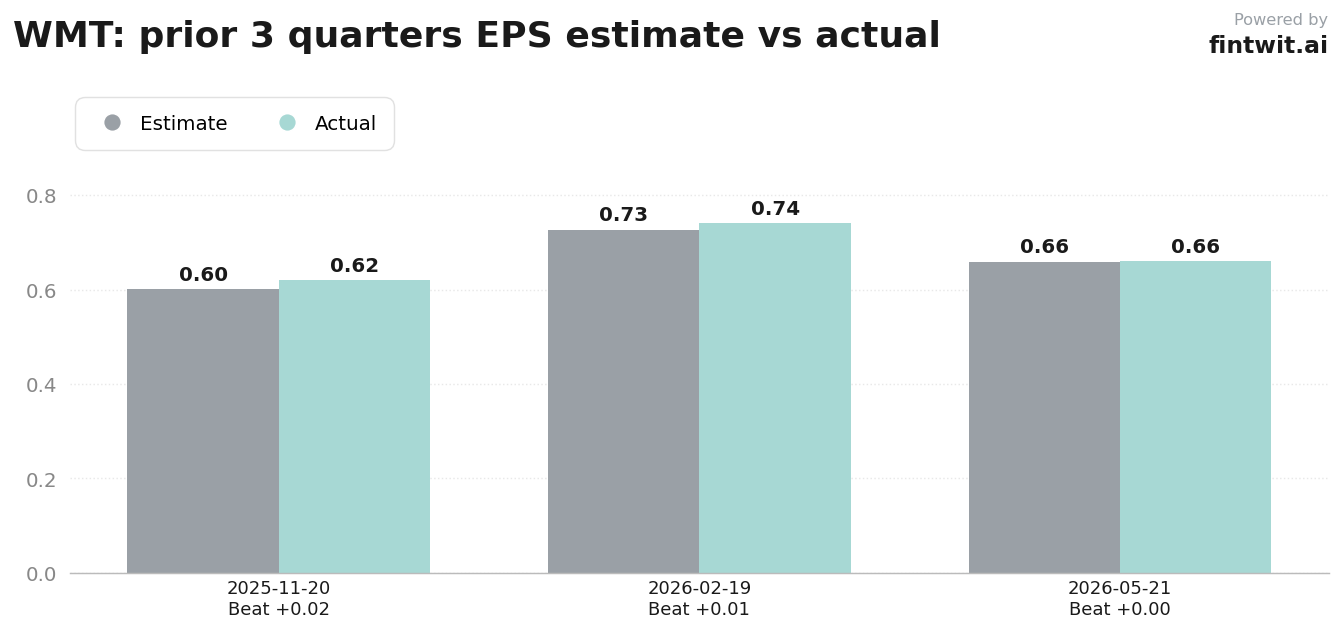
- Q1 2026 EPS: $0.66 (Beat estimate of $0.659)
- Q4 2026 EPS: $0.74 (Beat estimate of $0.727)
- Q3 2026 EPS: $0.62 (Beat estimate of $0.601)
What we'll watch on the call
The primary focus remains on whether the consumer is cracking or if recent retail sales weakness is merely a result of gasoline price volatility. Management's commentary on tariff-driven cost pass-throughs will be essential for assessing margin sustainability.
We are also monitoring the performance of general merchandise versus grocery sales. A shift in this ratio would indicate whether consumers are pulling back on non-essential spending.
- Walmart U.S. Comparable Sales: Analysts have lowered expectations to 2.5% to 3.5%.
- Global eCommerce & Advertising: Critical for proving profit leverage beyond core retail.
- General Merchandise: Insight into discretionary spending versus grocery staples.
- Tariff Strategy: How the company plans to manage cost increases without sacrificing market share.
- Full-Year Guidance: Whether the outlook supports a raise for the second half of 2026.
Fintwit's AI verdict
The data suggests that Walmart remains a defensive powerhouse capable of navigating inflationary pressures better than its peers. While macroeconomic uncertainty persists, the company's ability to capture share from higher-income households provides a unique tailwind.
Investors should weigh the potential for a beat-and-raise scenario against the risk of conservative guidance regarding second-half consumer demand.