
The setup
Ubiquiti (UI) arrives at its Q4 2026 earnings release under a cloud of volatility. The stock experienced a 42% decline in May 2026, driven by concerns over a shrinking cash cushion following aggressive share buybacks and debt repayment.
The company is currently defending against an August 2026 lawsuit alleging its technology facilitated foreign drone operations. This legal risk, combined with a series of critical security patches issued in July 2026, has created significant uncertainty regarding near-term enterprise demand.
- MarketBeat reports a consensus 'Moderate Buy' rating, though analyst targets remain highly divergent.
- Simply Wall St suggests the stock may be trading at a 58% premium to fair value when accounting for recent ethical and legal risks.
- Zacks Research recently lowered its Q1 2028 EPS estimates, citing a more cautious outlook on profitability.
Consensus numbers
Wall Street expects Ubiquiti to report earnings per share of $4.03 for the quarter ending June 30. Revenue is projected to reach approximately $850.5 million.
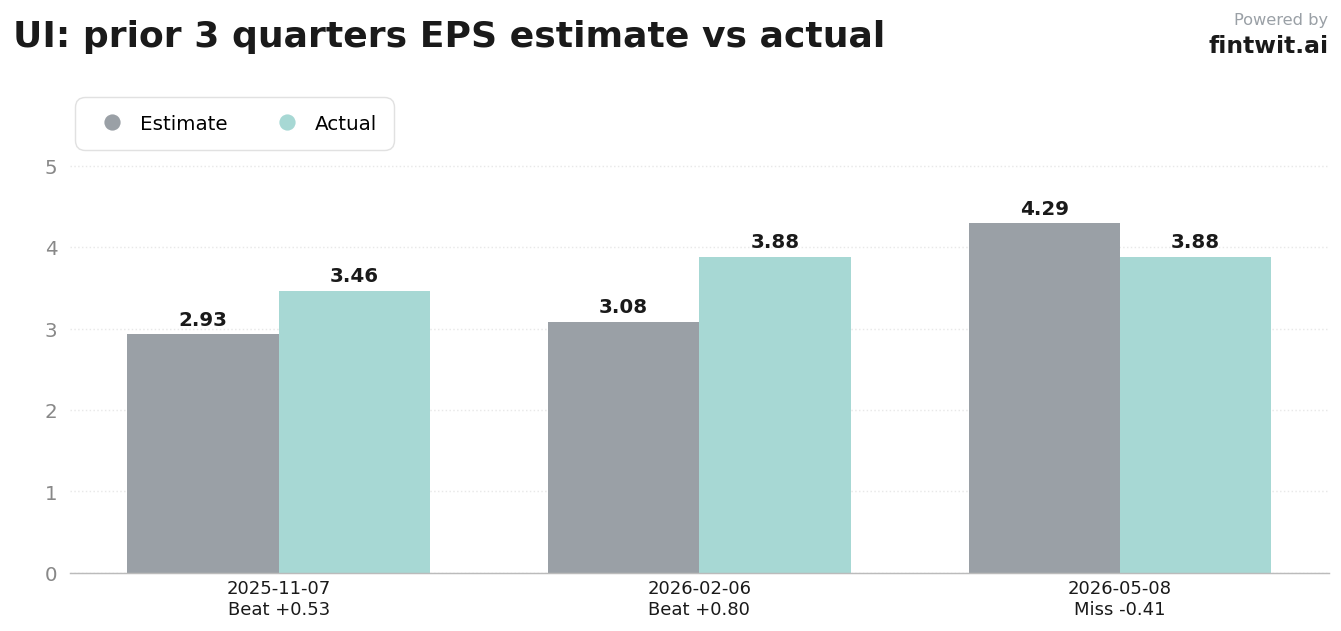
The company has shown a mixed track record in recent quarters, beating estimates in November 2025 and February 2026, but missing revenue expectations in May 2026.
- Q4 2026 EPS Estimate: $4.03
- Q4 2026 Revenue Estimate: $850.5 million
- November 2025: $3.46 EPS (Beat)
- February 2026: $3.88 EPS (Beat)
- May 2026: $3.88 EPS (Missed revenue estimate of $814.3M)
What we'll watch on the call
Management's commentary on margin protection remains the primary focus for institutional investors. Ubiquiti has historically provided limited forward guidance, which often exacerbates post-earnings price swings.
We are monitoring the Enterprise Technology segment, which accounts for over 70% of total revenue. Any signs of deceleration here would signal a major shift in the company's core growth engine.
- Impact of the August 2026 human rights lawsuit on enterprise client retention.
- Strategy for rebuilding cash reserves after recent capital allocation activities.
- R&D cost trajectory following the July 2026 critical security patch cycle.
- Management of component and freight expenses to maintain historical high-margin profiles.
- Stability of order activity within the Service Provider Technology segment.
Fintwit's AI verdict
The quantitative model suggests that the market has already priced in a significant portion of the recent legal and security-related negative sentiment. While the volatility in May 2026 was severe, the underlying demand for Wi-Fi 7 infrastructure and data sovereignty solutions provides a potential floor for the stock.
Investors should weigh the high probability of an earnings beat against the persistent lack of transparent forward guidance. The current valuation reflects a high degree of skepticism that may be corrected if management provides clarity on margin stability.