
The thesis
The travel and leisure industry is entering a phase defined by selective spending patterns. While the post-pandemic surge in demand for experiences remains, the current economic environment is forcing even affluent travelers to scrutinize their discretionary budgets.
Kate Ferrara of Deloitte notes that consumers are approaching spending with caution, a trend observed across all income levels. This shift suggests that growth in 2026 will be driven by operational efficiency and the ability to capture value-oriented segments rather than broad-based volume increases.
Why now
Inflationary pressures and persistent economic uncertainty are reshaping the competitive landscape. Companies that can leverage AI-driven personalization to maintain pricing power are better positioned to navigate this environment than those reliant on pure volume.
The current market environment rewards firms with strong balance sheets and clear differentiation. With interest rates remaining a factor, the cost of capital continues to influence expansion strategies for asset-heavy models like airlines and cruise lines.
Stocks we're watching
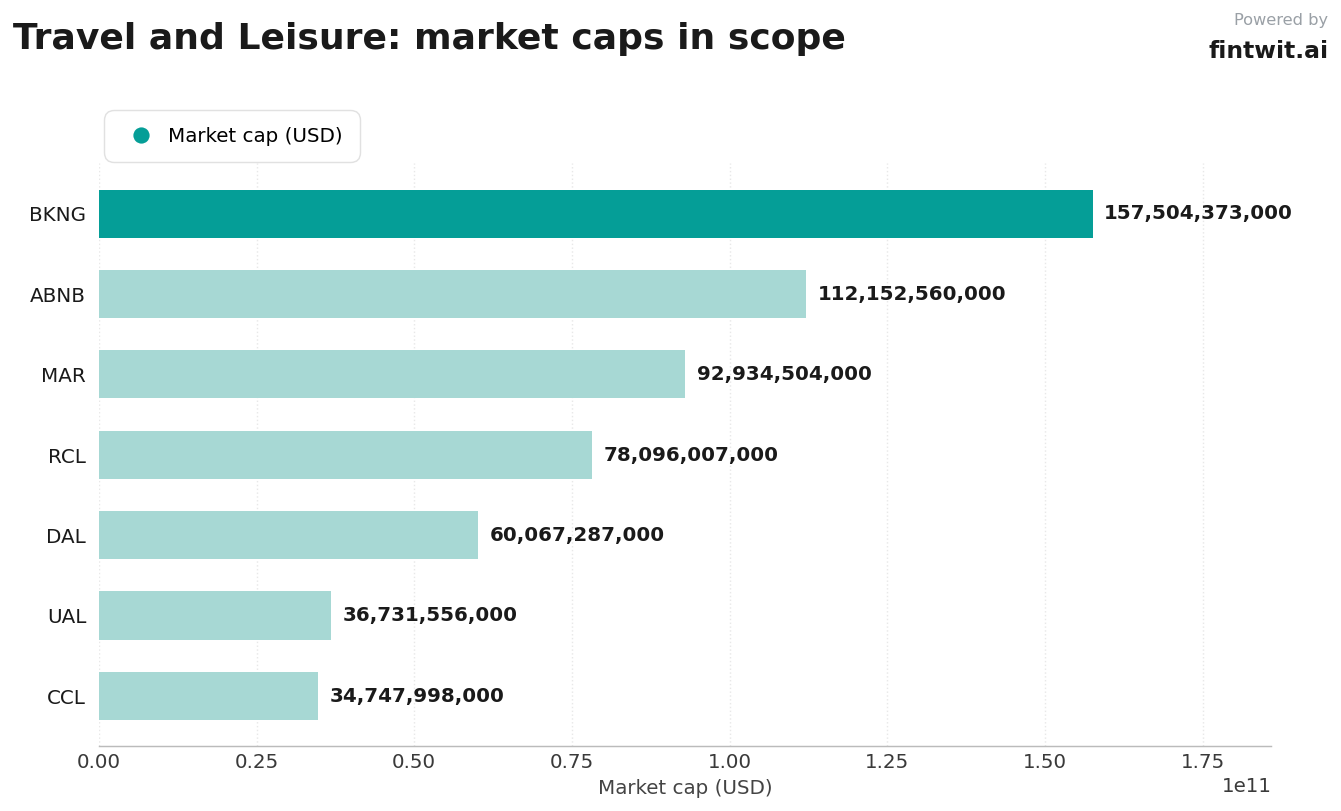
The following companies represent the core segments of the travel industry, ranging from digital aggregators to premium hospitality providers. Market capitalization data highlights the scale of these entities in the current cycle.
Investors should monitor how these firms manage their respective debt loads and loyalty ecosystems as consumer preferences evolve.
- BKNG (Booking Holdings): Digital Aggregator; leverages massive scale and AI-driven marketing to capture value-conscious travelers across global markets.
- ABNB (Airbnb): Alternative Accommodation; capitalizes on the travel like a local trend and demand for flexible, experiential stays.
- MAR (Marriott International): Premium Hospitality; relies on the robust Bonvoy loyalty ecosystem to maintain occupancy despite broader economic headwinds.
- DAL (Delta Air Lines): Premium Carrier; focuses on high-margin corporate and premium leisure segments to offset rising operational costs.
- UAL (United Airlines): Network Carrier; benefits from a resurgence in business travel and strategic network positioning.
- RCL (Royal Caribbean Cruises): Cruise Leader; maintains strong pricing power through differentiated, high-demand experiential cruise offerings.
- CCL (Carnival Corporation): Cruise Value Play; focuses on capacity optimization and debt management to navigate a competitive, cost-sensitive environment.
Risks that break it
The sector remains vulnerable to several macroeconomic and operational headwinds that could derail current growth projections. These risks are amplified by the industry's high sensitivity to input costs and geopolitical stability.
Management teams must balance the need for competitive pricing with the necessity of protecting margins in an inflationary environment.
- Economic bifurcation and financial caution leading to shorter, lower-cost trips and reduced premium segment performance.
- Geopolitical instability and regional conflicts disrupting travel corridors and increasing operational costs.
- High sensitivity to input costs, particularly fuel and labor, which threaten margins in asset-heavy models like airlines and cruises.