
Why these yields right now
The current market environment has pushed yields to levels not seen in years, driven by a combination of sector-specific headwinds and broader economic uncertainty. Many companies in the energy and asset management sectors are maintaining high payouts to retain investor interest despite declining share prices.
Yield is a function of price, meaning a falling stock price mathematically inflates the dividend percentage. Investors must distinguish between companies with structural cash flow issues and those simply caught in a broader market rotation.
Payout ratios are the primary metric for determining sustainability. A ratio exceeding 100% indicates that a company is paying out more than it earns, which often necessitates debt financing or the depletion of cash reserves to maintain the dividend.
The top yielders
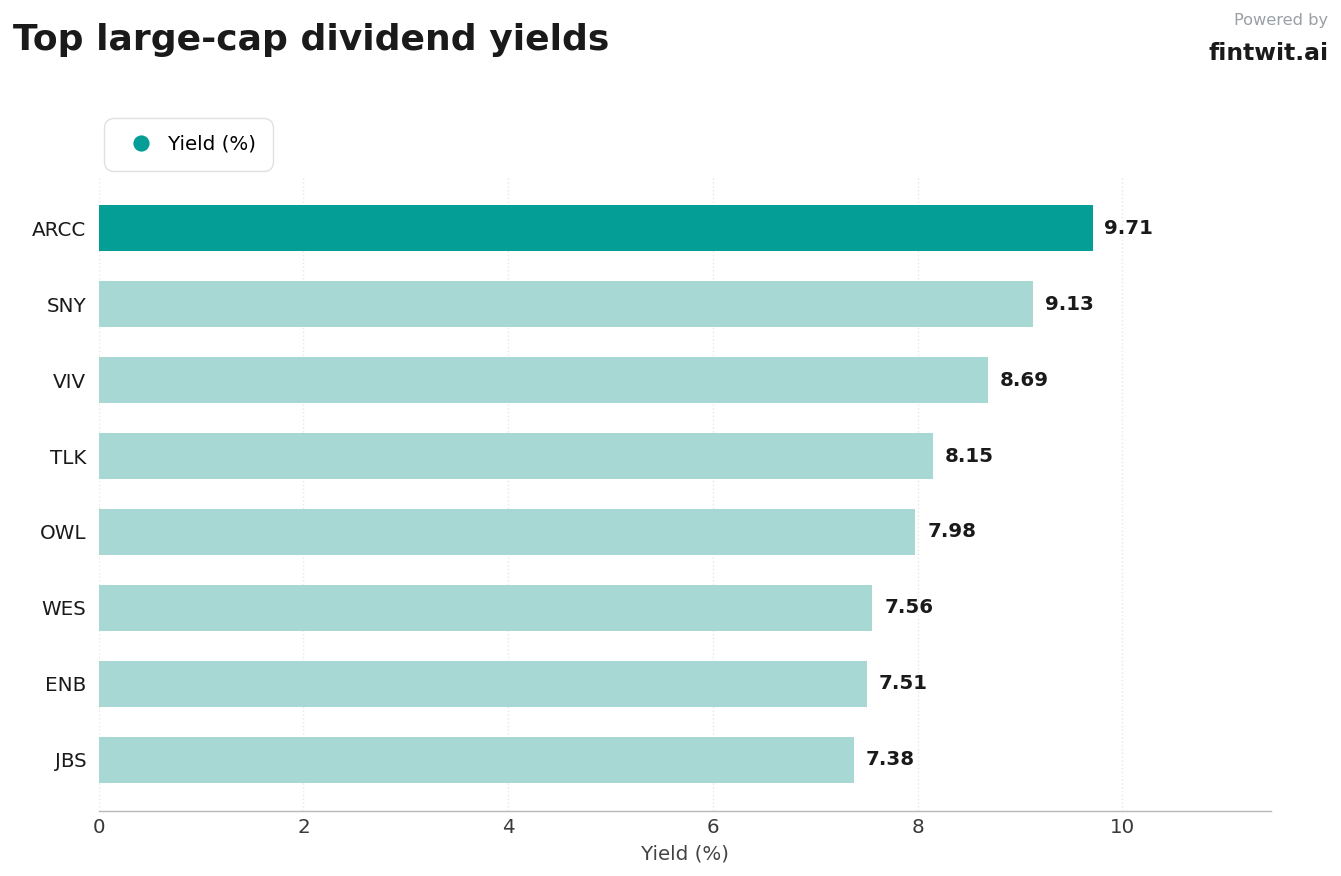
The following list highlights companies currently offering yields above 7%. We categorize these based on their payout ratios and historical ability to maintain distributions.
Investors should note that high yields in the energy and financial sectors often come with higher sensitivity to interest rate changes and commodity price fluctuations.
- Ares Capital (ARCC): 9.71% yield; 142.22% payout ratio; moderate safety rating.
- Sanofi (SNY): 9.13% yield; 92.15% payout ratio; caution advised.
- Telefonica Brasil (VIV): 8.69% yield; 78.21% payout ratio; mixed safety rating.
- Telkom Indonesia (TLK): 8.15% yield; 123.5% payout ratio; low safety rating.
- Blue Owl Capital (OWL): 7.98% yield; not covered by earnings; low safety rating.
- Western Midstream (WES): 7.56% yield; 116% payout ratio; moderate safety rating.
- Enbridge (ENB): 7.51% yield; 60-70% payout ratio; high safety rating.
- JBS N.V. (JBS): 7.38% yield; 98.04% payout ratio; low safety rating.
Yield traps
A yield trap occurs when a high dividend yield is unsustainable and likely to be cut. These companies often exhibit declining fundamentals that the market has already priced into the stock.
We identify these traps by looking for payout ratios consistently above 100% or management teams that have recently signaled a shift in capital allocation priorities.
- Blue Owl Capital (OWL): Recent base dividend cut in Q1 2026 to align with earnings power.
- Telkom Indonesia (TLK): Regulatory investigations and payout ratios exceeding 100% of net profit.
- JBS N.V. (JBS): Reliance on irregular special distributions rather than consistent earnings-backed payments.
- Sanofi (SNY): Pipeline uncertainty and high payout ratio relative to trailing earnings.
Build an income sleeve
Constructing a reliable income sleeve requires prioritizing cash flow stability over raw yield. Enbridge (ENB) stands out as a core holding due to its 31-year streak of dividend increases and a payout ratio strictly managed within the 60-70% range of distributable cash flow.
Diversification across sectors is essential to mitigate the risk of a single industry downturn. While ARCC provides significant income, its 142.22% payout ratio requires close monitoring of its lending environment and core earnings performance.
Investors should limit exposure to companies with irregular payment histories. Focus on entities that prioritize inflation-protected cash flows and have a clear, stated policy for dividend growth.