
The setup
TD Bank faces a complex macroeconomic environment as it prepares to report third-quarter results. Analysts are weighing the bank's operational resilience against a backdrop of shifting interest rate expectations from both the Federal Reserve and the Bank of Canada.
Market participants are particularly focused on whether the bank can sustain its current valuation premium. While management has guided for EPS growth exceeding 6-8% and an ROE of 13%, the recent year-to-date rally has left little room for error.
Brian Madden of First Avenue Investment Counsel notes that the primary risk is not the underlying performance, but rather the high bar set by investors. Maoyuan Chen at Morningstar adds that the sector is currently trading at a premium to fair value, with trade tariffs acting as a potential headwind.
- Management targets 3-4% expense growth for fiscal year 2026.
- Total provisions for credit losses are expected to remain in the 40-50 bps range.
- U.S.-Canada trade tensions remain a primary concern for long-term growth.
- The bank operates with a $2.1 trillion asset base.
Consensus numbers
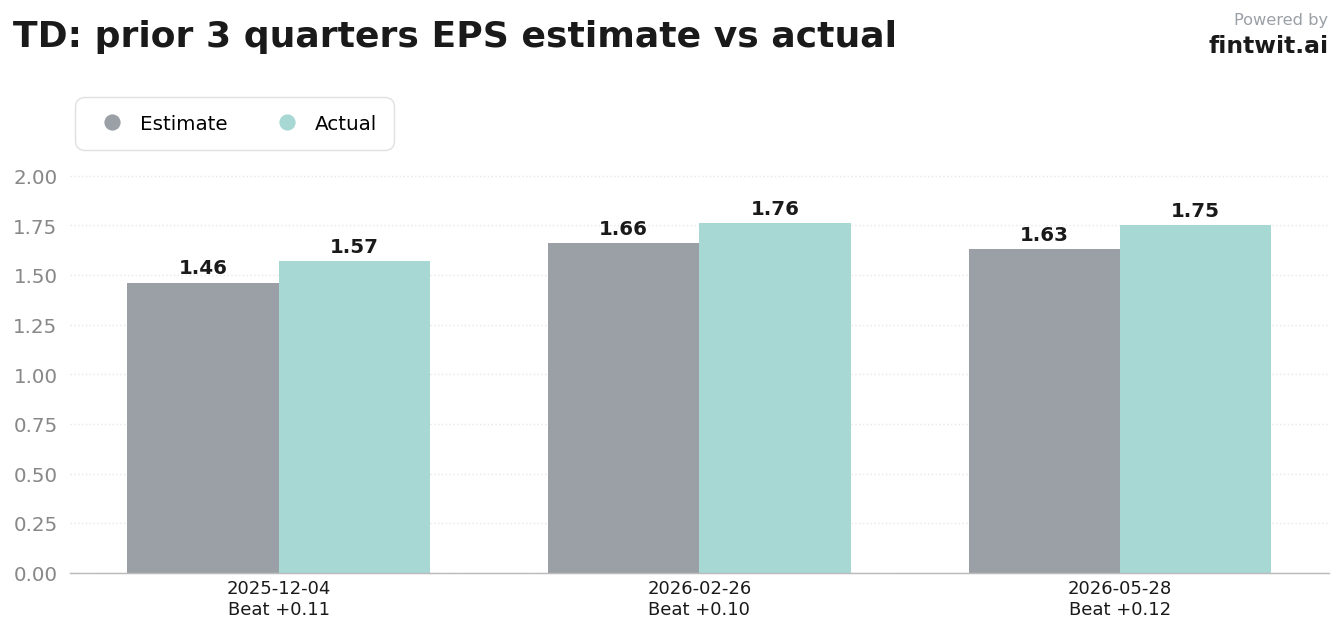
The consensus estimate for TD Bank's third-quarter earnings per share stands at 1.74, with revenue projected at 10.70 billion. These figures follow a strong first half of 2026 where the bank consistently outperformed analyst expectations.
The following data points summarize the current market expectations and recent performance history.
Zacks Equity Research highlights a positive Earnings ESP, suggesting the bank is well-positioned to maintain its current momentum.
- Consensus EPS Estimate: 1.74
- Consensus Revenue Estimate: 10.70 billion
- Q1 2026 Actual EPS: 1.76 (Estimated 1.66)
- Q2 2026 Actual EPS: 1.75 (Estimated 1.63)
- Q4 2025 Actual EPS: 1.57 (Estimated 1.46)
What we'll watch on the call
Investors will be looking for clarity on how the U.S. banking segment is navigating regulatory scrutiny and interest rate volatility. The performance of the proprietary card franchise will be a key indicator of consumer health.
Credit quality remains a central theme for the Canadian personal and commercial banking segment. Analysts are monitoring loan growth and net interest margin stability closely.
The wholesale banking division's contribution will be evaluated against the backdrop of a strong U.S. IPO market in 2026. Management's commentary on capital allocation and dividend sustainability will also be critical.
- Are provisions for credit losses tracking within the 40-50 bps guidance?
- How will potential U.S. tariffs on Canadian imports impact growth?
- What is the outlook for net interest margin stability in Canada?
- How is the U.S. proprietary card franchise performing under current rate conditions?
Fintwit's AI verdict
The quantitative models tracking TD Bank suggest that the current market pricing reflects a high degree of confidence in the bank's ability to navigate ongoing macroeconomic headwinds. While the valuation is stretched compared to historical averages, the consistent ability to exceed earnings estimates provides a unique buffer for shareholders.
Investors should weigh the potential for short-term volatility against the bank's long-term operational stability. The upcoming earnings call will likely serve as a catalyst for either a re-rating of the stock or a consolidation phase.