The thesis
The investment narrative for semiconductors has evolved from experimental AI training to the industrial-scale deployment of agentic systems. As AI models transition toward reasoning-heavy workloads, the industry requires a massive expansion in total compute capacity.
This shift creates durable, long-term demand across the entire supply chain. Success is no longer limited to high-end GPU designers, but extends to the firms providing the physical foundation for modern computing.
- Compute requirements are projected to grow tenfold over the next decade to support 100 billion AI agents.
- The supply chain now demands advanced logic fabrication, high-bandwidth memory, and custom silicon interconnects.
- Precision manufacturing equipment is the primary bottleneck for scaling production of sub-3nm chips.
Why now
Hyperscalers are currently shifting capital expenditure from pilot programs to permanent, industrial-scale AI infrastructure. This transition provides a recurring revenue floor for suppliers that were previously subject to volatile consumer electronics cycles.
The complexity of next-generation chips requires deeper integration between design, manufacturing, and packaging. This interdependence creates high barriers to entry for competitors, effectively protecting the margins of incumbent suppliers.
- AI infrastructure spending is transitioning from experimental to industrial-scale deployment.
- The industry is moving toward gate-all-around transistor architectures, increasing the need for specialized etching and deposition tools.
- High-bandwidth memory (HBM) is currently the most critical constraint on data throughput for large-scale AI clusters.
Stocks we're watching
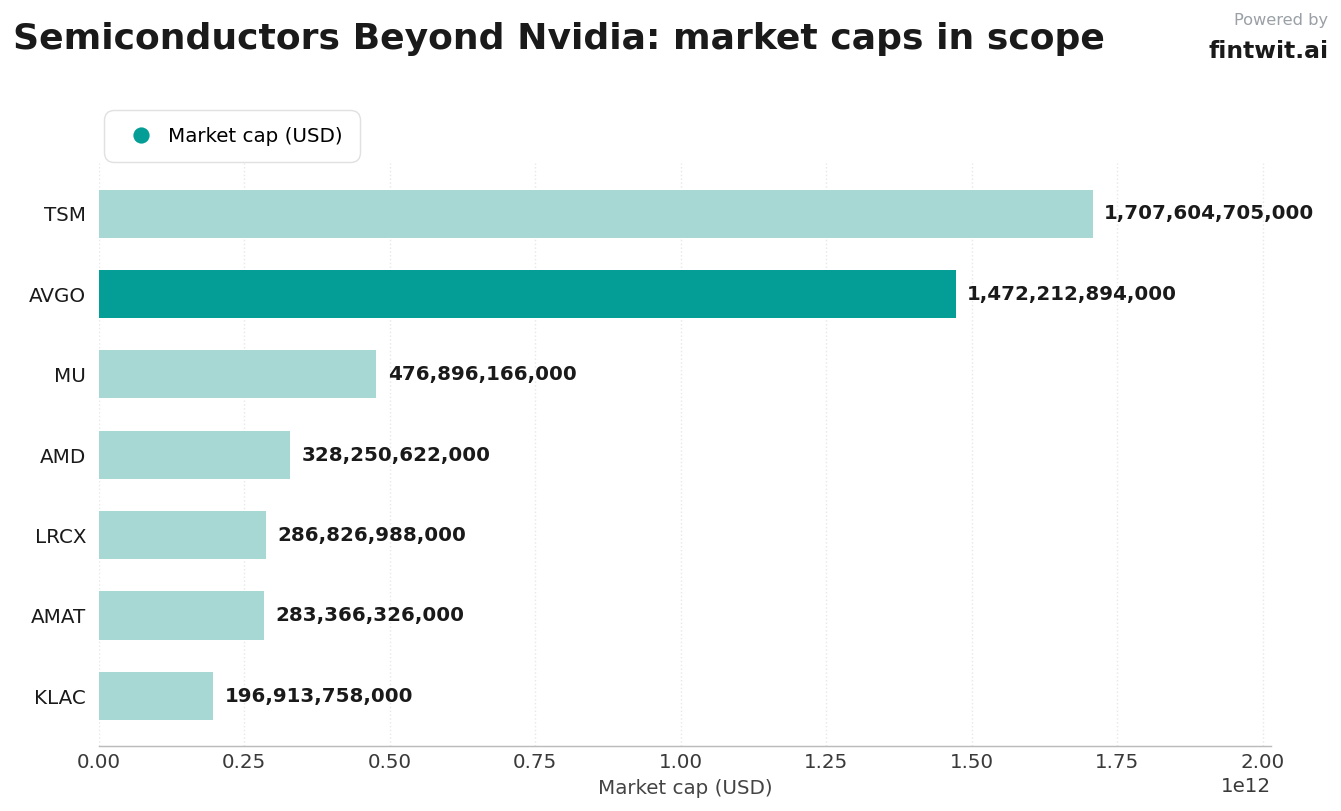
The following companies represent the physical backbone of the AI infrastructure super-cycle. Their market capitalizations reflect their critical roles in the global semiconductor ecosystem.
Investors should monitor these firms for their ability to maintain yield and throughput as manufacturing nodes shrink toward 2nm.
- AVGO (Broadcom): Provides essential custom ASICs and high-speed networking interconnects that enable massive GPU clusters to function as unified AI infrastructure.
- AMD (Advanced Micro Devices): Offers a diversified AI hardware portfolio, including server CPUs and Instinct GPUs, providing hyperscalers with a critical alternative to Nvidia.
- TSM (Taiwan Semiconductor): Acts as the indispensable manufacturing backbone for the global AI industry, holding a near-monopoly on the advanced nodes required for high-performance AI chips.
- MU (Micron Technology): Capitalizes on the surging demand for High-Bandwidth Memory (HBM), a critical bottleneck for AI performance and data throughput.
- AMAT (Applied Materials): Supplies the foundational manufacturing and advanced packaging equipment necessary to scale production of next-generation AI logic and memory chips.
- LRCX (Lam Research): Provides critical etching and deposition tools essential for manufacturing sub-3nm chips and gate-all-around transistors.
- KLAC (KLA Corporation): Ensures yield and reliability in complex manufacturing processes through industry-leading inspection and metrology equipment.
Risks that break it
The semiconductor sector remains highly sensitive to geopolitical tensions and macroeconomic shifts. While the long-term outlook is positive, specific risks could disrupt the current growth trajectory.
Investors must account for potential inventory corrections in non-AI end markets, such as automotive and industrial sectors, which may offset gains from AI-driven demand.
- Geopolitical instability and trade restrictions, particularly concerning Taiwan's central role in advanced chip manufacturing.
- Supply chain bottlenecks and talent shortages in specialized areas like advanced packaging, testing, and process control.
- Macroeconomic sensitivity and inventory cycles in non-AI end markets that can offset AI-driven growth.