The matchup
The enterprise software landscape is currently split between mature SaaS incumbents and aggressive cloud infrastructure providers. Salesforce occupies the application layer, relying on high switching costs and a massive installed base to maintain its market position.
Oracle has pivoted toward high-intensity AI infrastructure, betting its future on the massive demand for cloud compute. This shift has fundamentally altered its financial profile, moving it away from legacy database stability toward a high-capex growth model.
- Salesforce market capitalization stands at $183.07 billion.
- Oracle market capitalization is significantly larger at $414.24 billion.
- Salesforce maintains a focus on software-as-a-service (SaaS) efficiency and margin expansion.
- Oracle is prioritizing massive infrastructure build-outs to support AI compute demand.
Numbers side by side
Valuation metrics reveal a tight spread between the two, despite their divergent growth profiles. Investors are currently paying a premium for Oracle's top-line acceleration, while Salesforce is priced for steady, cash-generative performance.
The following metrics highlight the divergence in operational strategy and market sentiment as of the most recent fiscal reports.
- Price: Salesforce trades at $205.43; Oracle trades at $142.07.
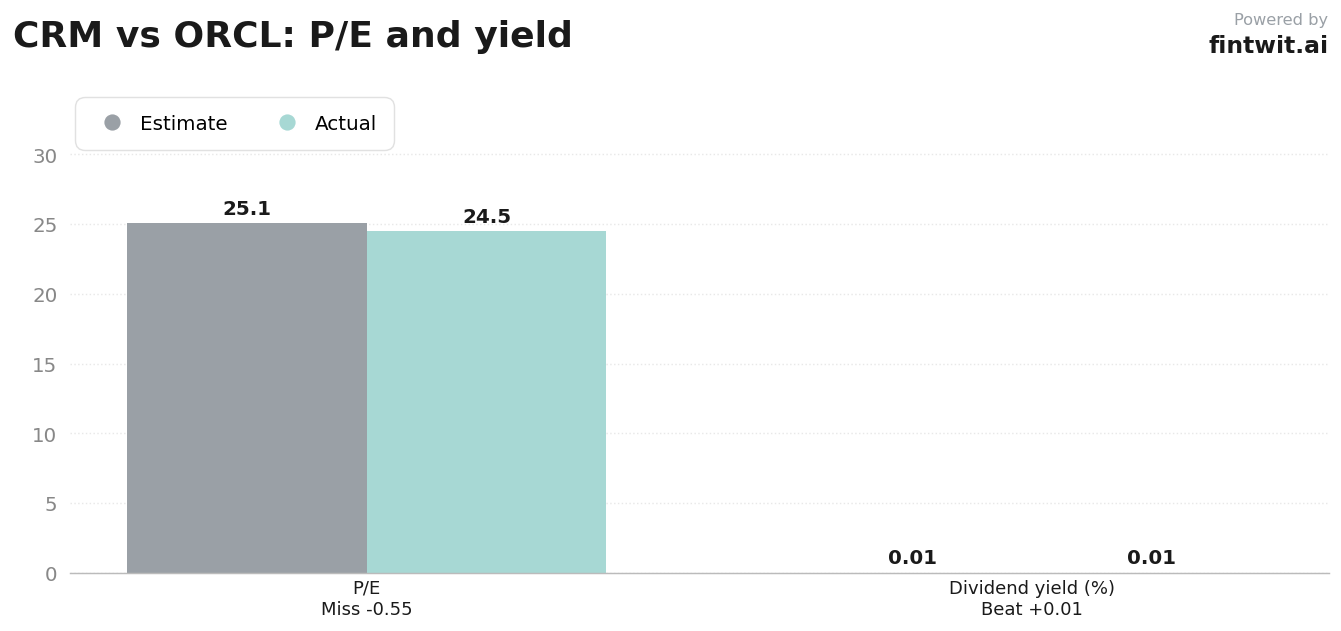
- P/E Ratio: Salesforce at 25.05x; Oracle at 24.50x.
- Revenue Growth: Salesforce 10% Y/Y; Oracle 21% Y/Y.
- Dividend Yield: Salesforce 0.85%; Oracle 1.40%.
- 90-Day Performance: Salesforce +16.52%; Oracle -25.14%.
Bull and bear on each
The investment case for Salesforce hinges on its ability to extract more value from its existing customer base through AI agents. Conversely, the bear case focuses on the risk of seat erosion as AI tools reduce the need for human-operated software licenses.
Oracle's bull case is anchored by its $638 billion remaining performance obligation (RPO), which provides high revenue visibility. However, the bear case warns that its $70 billion annual capital expenditure requirement could strain liquidity if AI demand cools.
- Salesforce Bull: Successful monetization of Agentforce and AI agents.
- Salesforce Bull: $50 billion share repurchase program provides an EPS floor.
- Salesforce Bear: Potential 'SaaSpocalypse' leading to seat erosion.
- Salesforce Bear: Saturation in core CRM markets limiting top-line growth.
- Oracle Bull: Dominant position in AI infrastructure and cloud database demand.
- Oracle Bull: Massive RPO backlog provides high future revenue visibility.
- Oracle Bear: Extreme capex requirements straining cash flow.
- Oracle Bear: Execution risk in converting infrastructure backlog to profit.
The verdict
Choosing between these two depends on an investor's tolerance for infrastructure-related execution risk versus the slower, more predictable growth of a mature SaaS model. Oracle offers superior top-line momentum, but it requires a high degree of confidence in the long-term sustainability of AI compute spending.
Salesforce provides a more defensive posture, leveraging its deep enterprise integration to weather market volatility. The decision ultimately rests on whether one believes the market will reward capital-intensive growth or operational efficiency in the coming fiscal year.