The matchup
Salesforce maintains a dominant 20% market share in the CRM software space, leveraging its 150,000-plus customer base to push its new Agentforce AI platform. The company is currently undergoing a transition toward an agentic enterprise operating system to sustain its 13.3% year-over-year revenue growth.
Oracle is aggressively expanding its footprint through the One Oracle Advantage, which integrates infrastructure, database, and application layers. This strategy has fueled a 21% year-over-year revenue growth rate as of Q4 FY26, though it requires massive capital expenditure.
- Salesforce relies on high switching costs and a massive ecosystem to maintain its competitive moat.
- Oracle utilizes a multi-cloud database strategy to capture market share from competitors.
- Both firms are heavily investing in AI to justify premium valuation multiples.
Numbers side by side
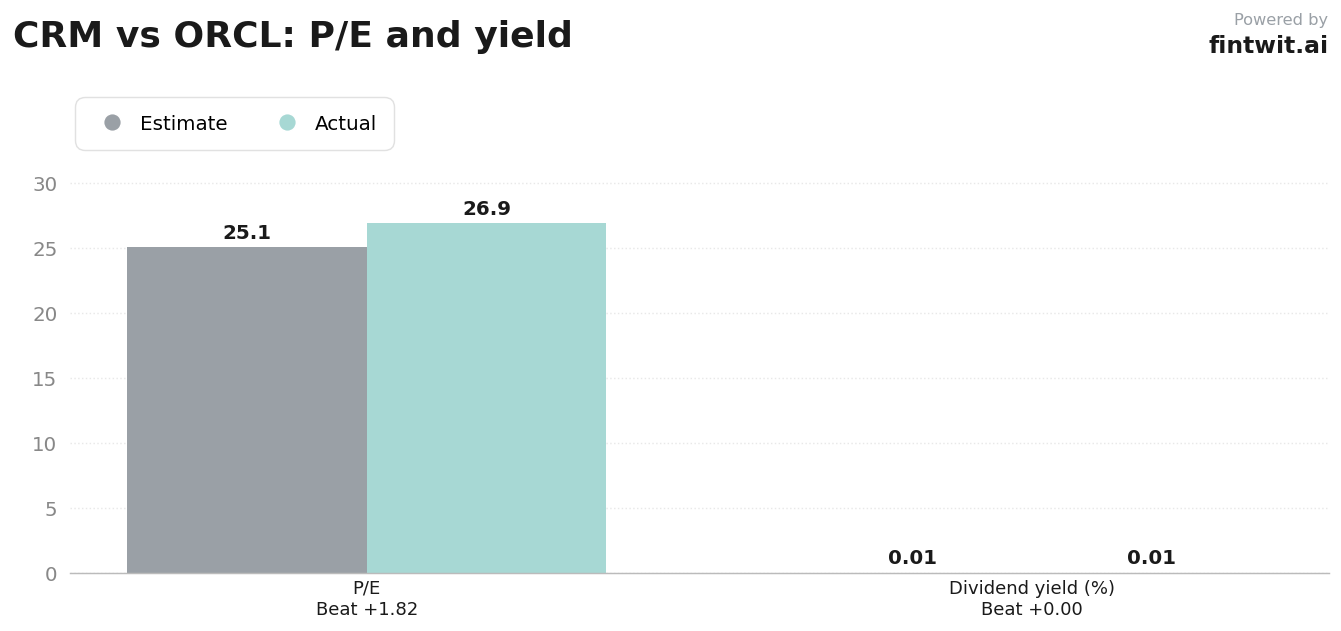
Valuation metrics reveal distinct profiles for these two technology titans. Salesforce trades at a P/E of 25.05, while Oracle sits slightly higher at 26.87.
The divergence in capital allocation is evident in their respective balance sheets and margin trends. Oracle is prioritizing aggressive infrastructure build-outs, whereas Salesforce is focused on share repurchases and margin expansion.
- Salesforce Market Cap: $183.07 billion.
- Oracle Market Cap: $430.49 billion.
- Salesforce Dividend Yield: 0.85%.
- Oracle Dividend Yield: 1.29%.
- Salesforce 1-Year Performance: -22.46%.
- Oracle 1-Year Performance: -42.47%.
- Salesforce Operating Margin: 34.1% (FY26 non-GAAP).
- Oracle Gross Margin: ~66% (reflecting infrastructure investment pressure).
Bull and bear on each
Investors must weigh the execution risks of Salesforce's AI pivot against Oracle's debt-funded infrastructure expansion. Each company faces unique headwinds in the current fiscal environment.
- Salesforce Bull: Agentforce AI adoption is expected to accelerate annual recurring revenue.
- Salesforce Bull: A $50 billion share repurchase program provides a floor for earnings per share.
- Salesforce Bear: Core CRM demand is slowing due to increased price sensitivity among enterprise clients.
- Salesforce Bear: Shifting from seat-based to consumption-based pricing creates significant execution risk.
- Oracle Bull: Cloud Infrastructure (OCI) revenue grew 93% in the most recent quarter.
- Oracle Bull: A $638 billion remaining performance obligation (RPO) backlog offers high revenue visibility.
- Oracle Bear: High leverage ratios approaching 5x EBITDA threaten the company's BBB- credit rating.
- Oracle Bear: Massive annual capital expenditures exceeding $50 billion result in negative free cash flow.
The verdict
Oracle presents a compelling case for investors focused on the infrastructure layer of the AI revolution, provided the company can manage its debt load. The massive RPO backlog serves as a buffer against short-term volatility in cloud demand.
Salesforce remains a high-quality software play, but its success depends on the rapid adoption of Agentforce. The company's ability to maintain margins while shifting its pricing model will be the primary determinant of its stock performance over the next 18 months.