The matchup
Salesforce and Oracle represent two distinct strategies for capturing enterprise AI spend. Salesforce focuses on embedding Agentforce into its existing CRM ecosystem to drive high-margin subscription revenue.
Oracle is betting its future on massive capital expenditure to build out high-performance AI infrastructure. The firm is leveraging its legacy database footprint to anchor its OCI cloud platform.
- Salesforce (CRM) market cap: $183.07 billion
- Oracle (ORCL) market cap: $430.49 billion
- CRM primary moat: Dominant CRM market share and deep enterprise integration
- ORCL primary moat: Mission-critical database footprint and high-performance OCI networking
Numbers side by side
Financial performance diverges significantly when comparing capital intensity and margin profiles. Salesforce demonstrates superior operating leverage, while Oracle shows faster top-line growth driven by infrastructure demand.
Investors must weigh Salesforce's $50 billion share repurchase program against Oracle's $638 billion AI infrastructure backlog.
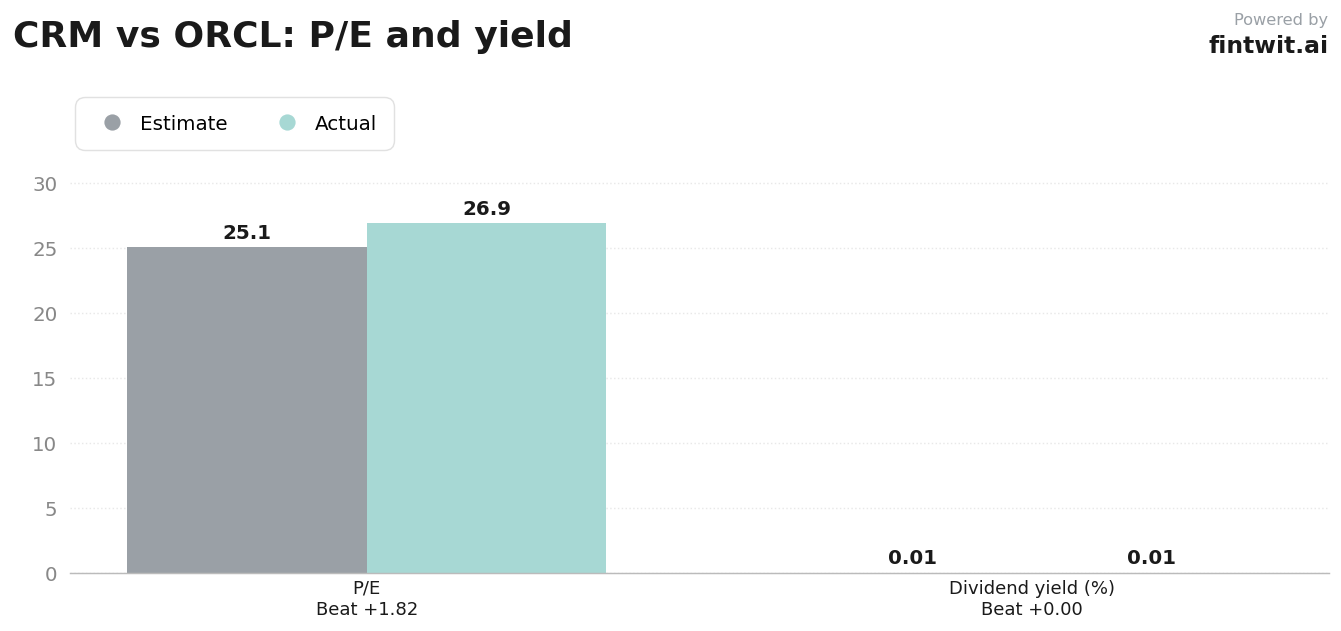
- CRM P/E Ratio: 25.05
- ORCL P/E Ratio: 26.87
- CRM Revenue Growth: 13% Y/Y (Q1 FY27)
- ORCL Revenue Growth: 21% Y/Y (Q4 FY26)
- CRM Dividend Yield: 0.85%
- ORCL Dividend Yield: 1.29%
- CRM 1-Year Price Change: -38.05%
- ORCL 1-Year Price Change: -39.62%
Bull and bear on each
The bull case for Salesforce rests on the successful monetization of Agentic Work Units. Conversely, the bear case highlights the risk of seat-based subscription cannibalization.
Oracle bulls point to the massive OCI backlog as evidence of AI dominance. Bears remain concerned about the balance sheet impact of debt-funded data center expansion.
- CRM Bull: Successful pivot to Agentic Enterprise driving organic growth
- CRM Bull: $50B share repurchase program provides EPS support
- CRM Bear: Execution risk in monetizing new AI-driven product metrics
- CRM Bear: Slowing growth in core CRM business as platform matures
- ORCL Bull: Explosive growth in OCI and AI infrastructure demand
- ORCL Bull: Competitive advantage in high-performance AI training via RDMA
- ORCL Bear: Extremely capital-intensive model leading to negative free cash flow
- ORCL Bear: High customer concentration and potential for contract non-fulfillment
The verdict
Salesforce offers a more balanced profile of high-margin software growth and aggressive capital returns. The company's ability to scale AI agents without proportional headcount increases provides a clear path to margin expansion.
Oracle remains a high-beta play on AI infrastructure. Its success depends entirely on whether the $638 billion backlog converts to high-margin revenue before the capital expenditure cycle drains free cash flow.