The matchup
Salesforce is pivoting its business model toward 'Agentforce' and Data Cloud to maintain its dominance in the CRM space. The company is currently focused on high-margin software delivery and deep enterprise integration.
Oracle is aggressively scaling its cloud infrastructure business, OCI, to capture the massive demand for AI training and inference. Its strategy relies on massive capital expenditure to build out data centers that support global enterprise workloads.
- Salesforce (CRM) market cap: $183.07 billion.
- Oracle (ORCL) market cap: $441.52 billion.
- Salesforce primary moat: High switching costs via deep CRM integration.
- Oracle primary moat: Mission-critical database dominance and OCI scalability.
Numbers side by side
The valuation gap between these two firms reflects their differing growth trajectories and capital intensity. Investors must weigh Salesforce's consistent margin expansion against Oracle's hyper-scale revenue growth.
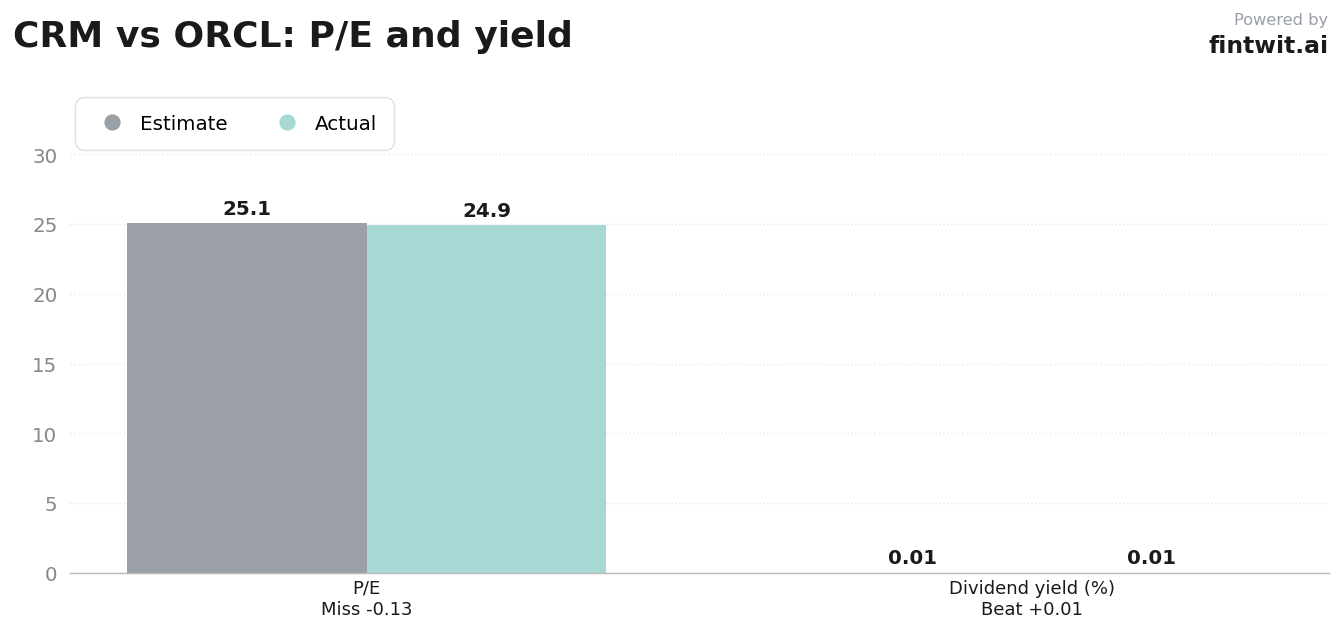
Refer to the valuation-side-by-side chart for a granular look at how these metrics compare across the current fiscal year.
- Salesforce P/E ratio: 25.05.
- Oracle P/E ratio: 24.92.
- Salesforce revenue growth: 10% Y/Y (Q2 FY26).
- Oracle revenue growth: 21% Y/Y (Q4 FY26).
- Salesforce dividend yield: 0.85%.
- Oracle dividend yield: 1.37%.
- Salesforce 90-day price change: +20.16%.
- Oracle 90-day price change: -20.14%.
Bull and bear on each
The bull case for Salesforce centers on the successful adoption of AI agents, while the bear case highlights the risk of decelerating enterprise IT budgets. Oracle's bull case is anchored by its massive $638 billion backlog, though bears point to the risks associated with its heavy debt and CapEx requirements.
- CRM Bull: Agentforce adoption drives significant seat-based revenue growth.
- CRM Bull: $50 billion buyback program supports EPS expansion.
- CRM Bear: Core enterprise growth is decelerating as budgets shift to infrastructure.
- CRM Bear: Generative AI threatens traditional seat-based pricing models.
- ORCL Bull: OCI growth captures significant demand from AI leaders.
- ORCL Bull: Record $638 billion backlog provides high revenue visibility.
- ORCL Bear: Massive AI capital expenditure creates financing risks.
- ORCL Bear: Heavy dependence on specific AI partners creates execution risk.
The verdict
Choosing between these two depends on whether an investor prefers the high-margin, software-centric approach of Salesforce or the infrastructure-heavy, hyper-growth model of Oracle. Both companies are navigating the AI transition with distinct strategies that cater to different segments of the enterprise market.
The market's reaction to upcoming quarterly earnings will likely determine which of these two firms captures the next wave of institutional capital. Investors should monitor the divergence in their respective growth rates as a primary indicator of future performance.