
The thesis
The restaurant industry is moving away from aggressive price-hiking cycles that defined the 2023-2025 period. Operators are now prioritizing value-first strategies to re-engage a cost-conscious consumer base currently navigating a K-shaped economic recovery.
Success in 2026 hinges on balancing operational efficiency with authentic value propositions. Brands that fail to address stagnant traffic and margin pressure through labor productivity will likely see further valuation compression.
Why now
Pricing power has reached a ceiling, forcing a strategic reset across the sector. According to the National Restaurant Association 2026 report, consumer resistance to menu price increases has hit a multi-year high, particularly among low-to-middle income cohorts.
Operators are now forced to optimize unit economics to protect margins without alienating the core customer. This transition marks the beginning of what analysts call the great margin rebuild.
Stocks we're watching
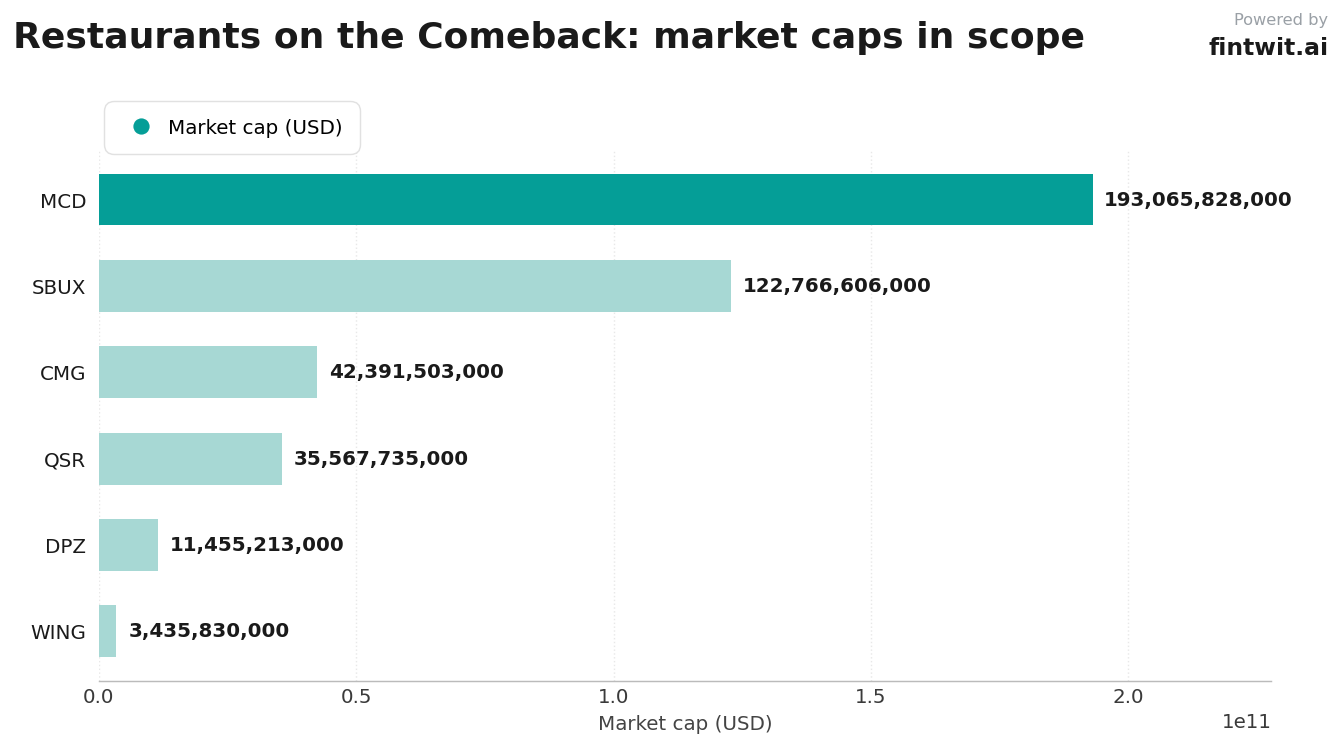
The following tickers represent the primary battlegrounds for the 2026 restaurant recovery. Market capitalization data highlights the scale of these operators as they navigate this transition.
Investors should monitor how these specific roles influence overall portfolio performance in a traffic-constrained environment.
- MCD (McDonald's): Value Anchor; leveraging the McDonald's > NEXT strategy to reclaim traffic through everyday affordable pricing.
- CMG (Chipotle): Growth Rebound; positioned for a reversal as strategic growth investments begin to yield improved unit economics.
- SBUX (Starbucks): Premium Resilience; focusing on brand loyalty and operational discipline to maintain its market position.
- DPZ (Domino's): Delivery Specialist; capitalizing on the stabilization of off-premise demand in the pizza segment.
- QSR (Restaurant Brands): Diversified Operator; utilizing its multi-brand portfolio to hedge against sector-specific volatility.
- WING (Wingstop): Niche Disruptor; targeting growth through a high-margin, chicken-centric model for digital-native demographics.
Risks that break it
The recovery thesis remains vulnerable to several structural headwinds that could derail margin expansion. Management teams must navigate these risks while maintaining operational momentum.
Failure to manage these variables will likely result in continued underperformance relative to broader market indices.
- Persistent margin compression due to structurally higher labor and food costs.
- Consumer friction fatigue and resistance to further price hikes among core demographics.
- Operational vulnerability from deferred maintenance and equipment breakdowns as operators prioritize short-term cash flow.