The matchup
NVIDIA currently dictates the pace of the global AI infrastructure build-out through its proprietary CUDA software stack and vertical integration. The company's Blackwell and Rubin product cycles are designed to maintain this lead against all competitors.
AMD is positioning itself as the primary alternative for enterprise AI, leveraging an open-source strategy through ROCm and UALink. The company's Helios rack-scale platform is specifically built to challenge Nvidia's data center footprint.
- NVIDIA's moat is built on the CUDA ecosystem and massive cash reserves for R&D.
- AMD's moat relies on chiplet-based architectural flexibility and a client-to-cloud footprint.
- NVIDIA faces high customer concentration risks among hyperscalers.
- AMD requires flawless execution to justify its current valuation premium.
Numbers side by side
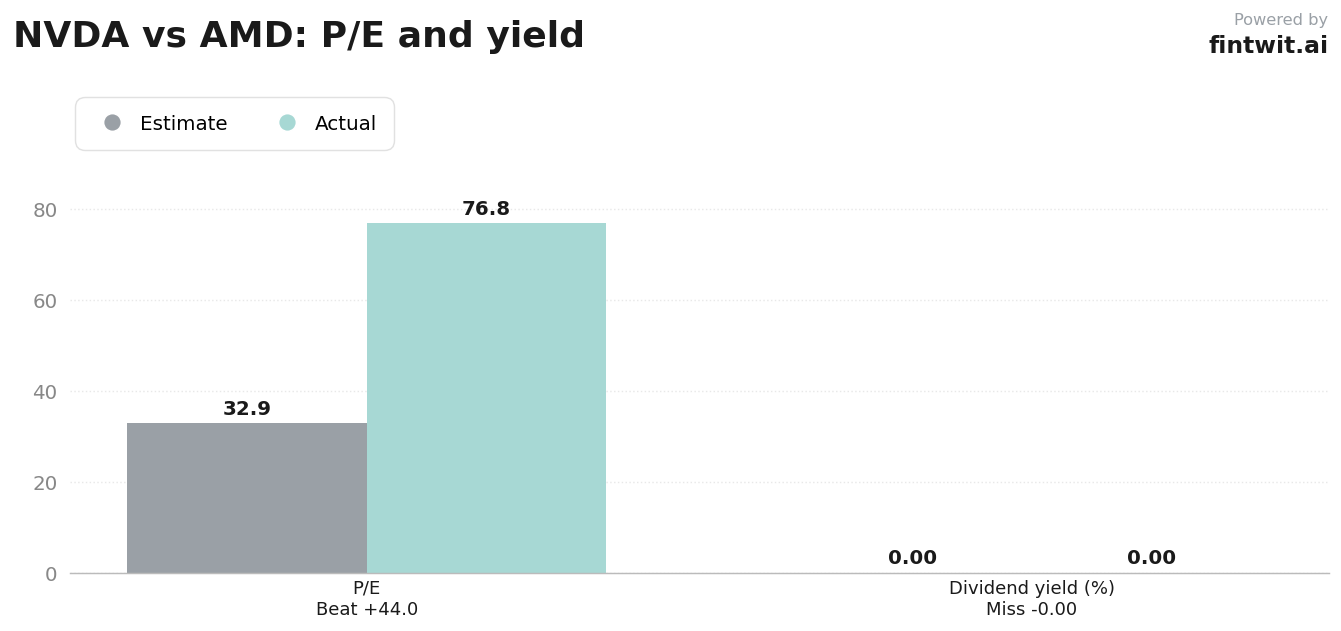
Financial performance diverges significantly between the two semiconductor giants. NVIDIA maintains a massive scale advantage, while AMD trades at a higher valuation multiple relative to its current earnings.
Investors should monitor the gross margin trends closely, as supply chain costs for high-bandwidth memory continue to pressure the entire sector.
- NVIDIA P/E Ratio: 32.88x.
- AMD P/E Ratio: 76.84x.
- NVIDIA Revenue Growth: 97% YoY (expected Q2 FY2027).
- AMD Revenue Growth: 50% YoY (Q2 2026).
- NVIDIA Operating Margin: ~75% (TTM).
- AMD Operating Margin: 17% (GAAP).
- NVIDIA 1-Year Return: 17.21%.
- AMD 1-Year Return: 187.59%.
Bull and bear on each
Market sentiment remains heavily skewed toward NVIDIA, though analysts are increasingly optimistic about AMD's ability to capture secondary market share.
The divergence in analyst targets reflects the uncertainty surrounding how much of the AI spend will remain proprietary versus shifting to open-source standards.
- NVIDIA Bull: Continued dominance in AI infrastructure with Blackwell/Rubin cycles.
- NVIDIA Bull: Strong operating leverage and massive free cash flow generation.
- NVIDIA Bear: High customer concentration creates revenue volatility risk.
- NVIDIA Bear: Michael Burry cites AI bubble concerns and competitive threats.
- AMD Bull: Accelerating Data Center revenue growth of 107% YoY in Q2.
- AMD Bull: Successful ramp of Helios rack-scale AI platform.
- AMD Bear: High valuation requires perfect execution to maintain growth.
- AMD Bear: Open-source ecosystem may scale slower than proprietary stacks.
The verdict
Nvidia maintains superior profitability and a deeper software-driven moat that currently dictates industry standards. The company's ability to leverage its balance sheet to catalyze third-party AI infrastructure financing remains a unique competitive advantage.
AMD could emerge as the winner if the market shifts decisively toward open-source standards like ROCm and Ultra Ethernet. Such a transition would require Nvidia's proprietary stack to face significant antitrust or interoperability headwinds.