The matchup
NVIDIA maintains a dominant position in the AI compute market, supported by its proprietary CUDA software ecosystem and rapid innovation cycles like the Rubin architecture. The company leverages a massive $500B+ financing ecosystem to secure long-term demand from hyperscalers.
AMD challenges this vertical integration through a client-to-cloud footprint that spans Ryzen processors to EPYC server CPUs and Instinct accelerators. The company focuses on open-source standards like ROCm, UALink, and Ultra Ethernet to provide a flexible alternative to proprietary stacks.
- NVIDIA market capitalization stands at $5.45 trillion.
- AMD market capitalization is $328.25 billion.
- NVIDIA operates with a TTM operating margin of 74.85%.
- AMD reported 50% YoY revenue growth in Q2 2026.
- NVIDIA's moat is built on deep software-hardware synergy and developer lock-in.
- AMD's moat relies on chiplet architecture leadership and open-standard coalitions.
Numbers side by side
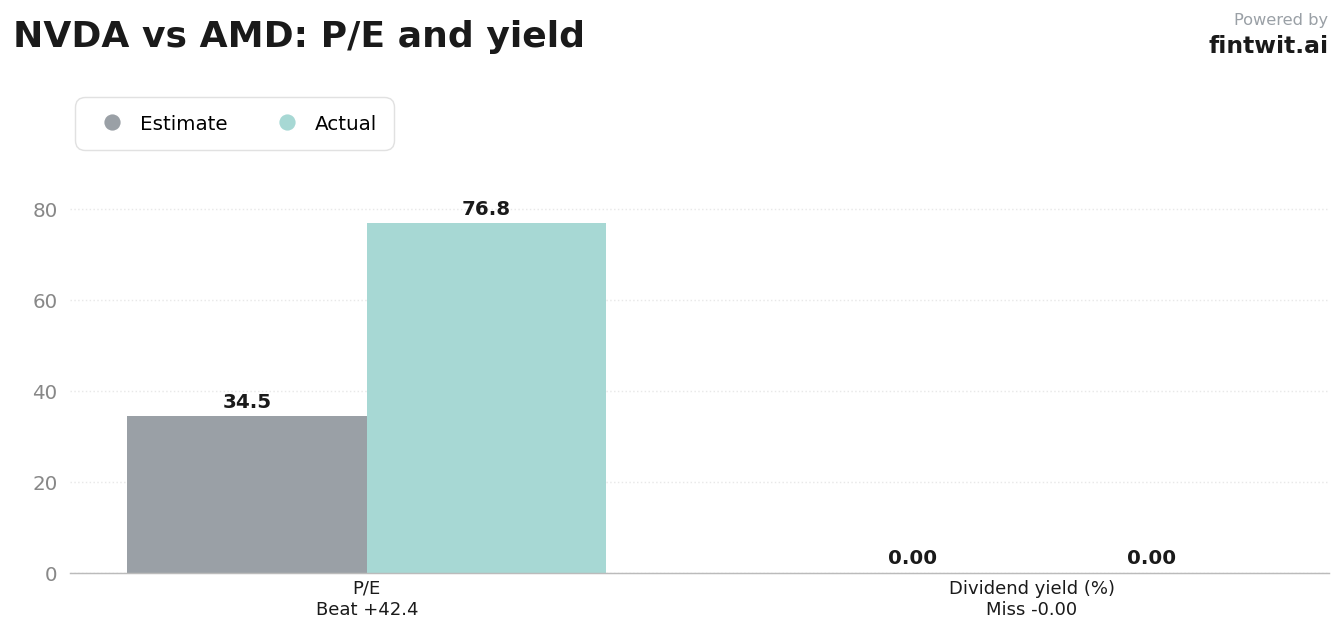
Valuation metrics highlight the divergence in market pricing between the two semiconductor leaders. NVIDIA trades at a P/E ratio of 34.48, reflecting its massive scale and profitability, while AMD trades at a higher P/E of 76.84, indicating aggressive growth expectations.
The following metrics provide a snapshot of current financial performance and market sentiment for both companies.
- NVDA P/E Ratio: 34.48
- AMD P/E Ratio: 76.84
- NVDA 1-Year Return: 24.78%
- AMD 1-Year Return: 189.78%
- NVDA Dividend Yield: 0.02%
- AMD Dividend Yield: 0.00%
- Baird analyst Tristan Gerra maintains a $1,250 target for AMD.
- Market consensus target for NVDA is $305.94.
Bull and bear on each
Investor sentiment varies significantly based on the perceived sustainability of AI infrastructure spending. Bull cases focus on long-term compute demand, while bear cases highlight valuation risks and potential competitive shifts.
The following points summarize the primary arguments for and against both companies.
- NVDA Bull: Dominance in AI compute with next-gen Rubin architecture.
- NVDA Bull: Strategic use of $500B+ financing to lock in demand.
- NVDA Bear: Extreme valuation sensitivity and high investor expectations.
- NVDA Bear: Risk of hyperscaler capex slowdown or infrastructure saturation.
- AMD Bull: Rapid adoption of Instinct accelerators and Helios racks.
- AMD Bull: Expansion of server CPU TAM to $200B+ by 2030.
- AMD Bear: Margin skepticism due to product mix shift toward lower-margin accelerators.
- AMD Bear: Execution risk against NVIDIA's entrenched vertical integration.
The verdict
Determining the superior investment requires weighing NVIDIA's software-backed moat against AMD's open-source strategy. NVIDIA's ability to maintain high margins through its proprietary ecosystem remains a significant differentiator in the current market environment.
AMD offers a compelling growth narrative if the industry shifts toward open-standard hardware and software. Investors must decide if the premium valuation of NVIDIA is justified by its infrastructure dominance or if AMD's flexibility provides a better long-term risk-reward profile.