The headline number
Marathon Petroleum currently commands a market capitalization of $105.3 billion. Its valuation sits at a P/E ratio of 12.5x, which remains conservative relative to its historical cash flow generation.
The company maintains a dividend yield of 1.12%. Management has signaled a commitment to sustained capital returns, projecting 2026 standalone capital spending of $1.5 billion.
- Market Cap: $105.3 billion
- P/E Ratio: 12.5x
- Dividend Yield: 1.12%
- 180-Day Performance: +85.18%
Peer comparison
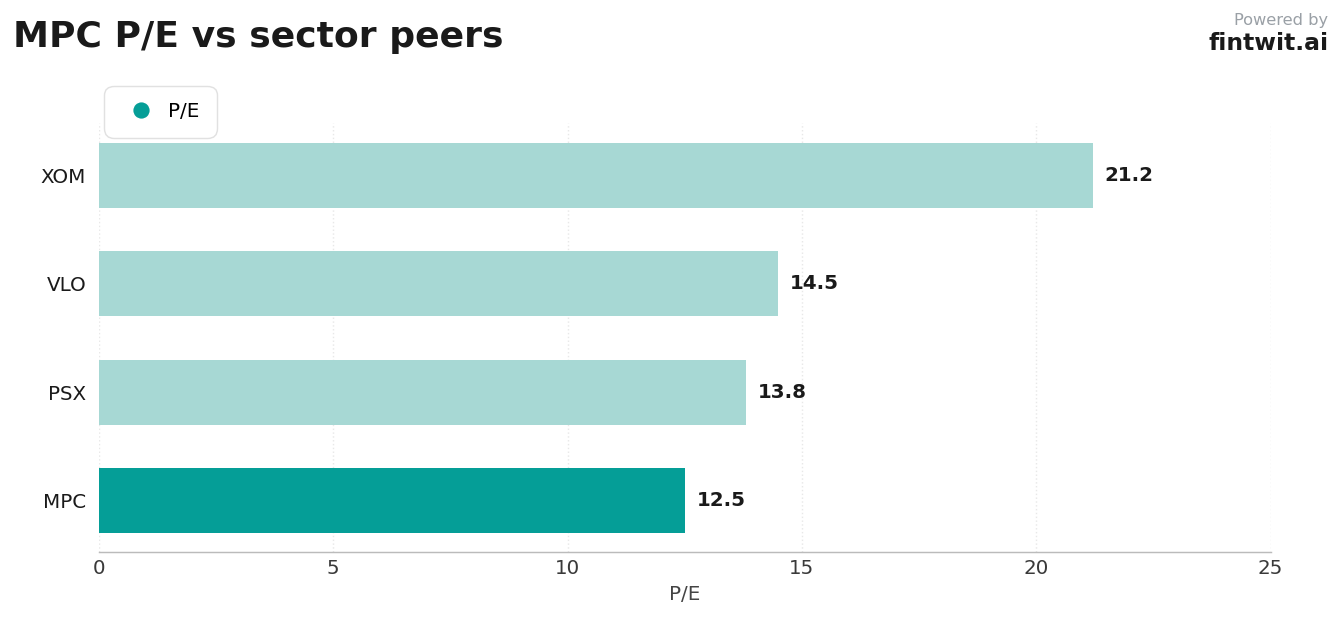
MPC's valuation profile differs significantly from its integrated and pure-play peers. The market currently assigns a lower multiple to MPC compared to its primary refining competitors.
Analysts note that MPC's sour crude diet and integrated system provide a competitive moat that is not fully captured in its current P/E multiple.
- PSX (Phillips 66): 13.8x P/E ratio, reflecting a different asset mix.
- VLO (Valero Energy Corp): 14.5x P/E ratio, serving as the pure-play refining benchmark.
- XOM (Exxon Mobil): 21.2x P/E ratio, reflecting its integrated supermajor risk profile.
Bull vs bear
The bull case centers on structural capacity tightness in the U.S. refining sector, which is expected to support elevated crack spreads through 2030. Conversely, the bear case highlights the cyclical nature of refining margins and the risk of mean reversion.
Management expects to remain in an enhanced mid-cycle environment through 2027, supporting the bullish outlook on operational efficiency.
- Bull: Aggressive capital return program with $3.5B+ annual distributions from MPLX.
- Bull: High-return growth projects at Garyville and Robinson sites.
- Bear: Refining margins are cyclical and prone to sudden mean reversion.
- Bear: Long-term demand risks associated with the energy transition.
- Risk: Regulatory compliance costs, specifically California's SB X1-2 mandates.
- Risk: Operational volatility and unplanned downtime impacting utilization rates.
Fintwit's AI verdict
The consensus among analysts remains divided, with firms like Goldman Sachs and UBS maintaining a constructive view on the company's earnings durability. Capital Markets Research, however, suggests the current valuation has already priced in the sector's tailwinds.
Investors should weigh the sustainability of current crack spreads against the company's aggressive share buyback and dividend strategy. The path forward depends heavily on the stability of global refining margins and the execution of ongoing growth projects.