
Why insider buys matter
Academic research consistently shows that insider purchases outperform the broader market by an average of 6% annually. Executives possess non-public information regarding operational efficiency, product pipelines, and long-term strategic pivots that are not yet reflected in current share prices.
Not all insider trades carry equal weight. Open-market purchases, where an executive uses their own capital to buy shares at market prices, are significantly more bullish than option exercises or automatic sales. These transactions represent a direct bet on the future cash flows of the company.
- Open-market buys indicate management believes the stock is undervalued relative to its intrinsic worth.
- High-conviction buying by C-suite executives often precedes positive earnings surprises or strategic restructuring announcements.
- Retail investors can use these filings to identify potential entry points during periods of high market volatility or sector-specific sell-offs.
The buyers
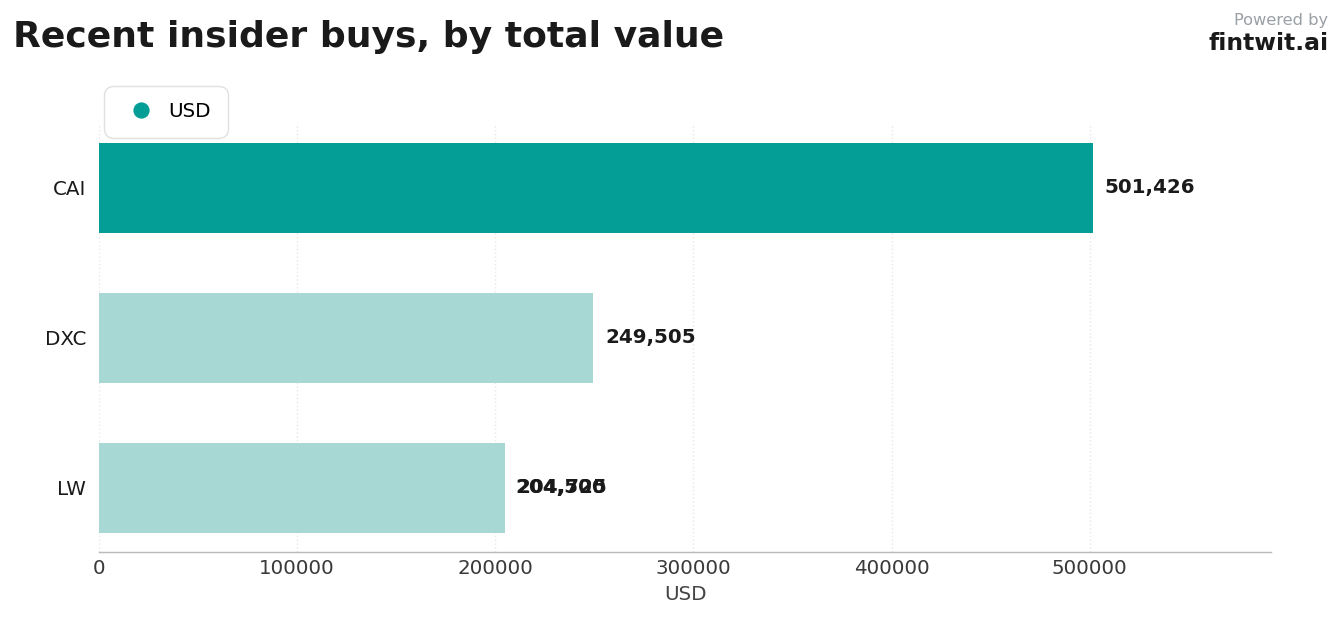
The following table summarizes the most significant open-market purchases reported for May 11, 2026. These transactions represent a combined capital deployment of nearly $1 million across the healthcare, technology, and consumer defensive sectors.
- Vacirca Jeff L (Director) bought $501,426 of Caris Life Sciences (CAI) at $16.149 per share.
- FERNANDEZ RAUL J (CEO) bought $249,505 of DXC Technology (DXC) at $8.895 per share.
- Gray James D (CFO) bought $409,225 of Lamb Weston (LW) across two separate transactions at an average price of $40.92 per share.
Stock-by-stock read-through
Each of these companies faces unique headwinds, making the insider buying activity a critical data point for assessing the risk-reward profile of these specific equities.
The following breakdown highlights the bull and bear cases for each ticker based on recent operational performance and market sentiment.
- CAI: Bull case rests on 79% YoY revenue growth and new diagnostic test approvals; bear case remains the lack of profitability and high cash burn.
- DXC: Bull case is the potential of the new OASIS AI platform to stabilize margins; bear case is the ongoing securities investigation and declining legacy IT revenue.
- LW: Bull case is the potential for margin improvement under activist pressure; bear case is the current operational inefficiency and market skepticism regarding management's turnaround plan.
How to trade the signal
Investors should treat insider buying as a secondary indicator rather than a primary thesis. Use these filings to confirm your own fundamental research rather than as a standalone reason to initiate a position.
Monitor the timing of these purchases relative to upcoming quarterly earnings reports. Buying activity that occurs shortly before a scheduled earnings release often suggests that management expects to meet or exceed consensus estimates.
Consider the size of the purchase relative to the insider's total holdings. A purchase that represents a significant portion of an executive's net worth is a stronger signal than a nominal buy that may be intended solely for optics.
- Check the SEC Form 4 filings on the EDGAR database to confirm the transaction type and date.
- Compare the purchase price to the stock's 52-week low to determine if the insider is buying at a technical support level.
- Watch for concurrent buying by multiple insiders, which indicates a broader consensus within the leadership team regarding the company's valuation.