
The setup
Home Depot management previously reaffirmed its fiscal 2026 guidance, projecting total sales growth of 2.5% to 4.5%. This outlook relies heavily on a second-half recovery driven by normalized storm activity rather than a broad rebound in underlying consumer demand.
The company is currently operating under a leadership transition due to the temporary medical leave of CEO Ted Decker. Investors are scrutinizing whether this absence impacts operational execution or the integration of recent acquisitions like SRS Distribution and GMS.
- Market sentiment remains cautious due to persistent inflationary pressures on discretionary budgets.
- Elevated mortgage rates continue to suppress demand for major home renovations.
- Analysts from Bank of America maintain a Buy rating with a $412 price target, citing conviction ahead of the print.
- TD Cowen analysts increased their price target to $410, reflecting confidence in the company's long-term positioning.
- Morningstar analyst Jaime M. Katz views the shares as fairly valued at $325, emphasizing the importance of Pro business integration.
Consensus numbers
Wall Street consensus estimates for the second quarter point to a revenue figure of $47.27 billion. The market is looking for an EPS of $4.73 to confirm business stabilization.
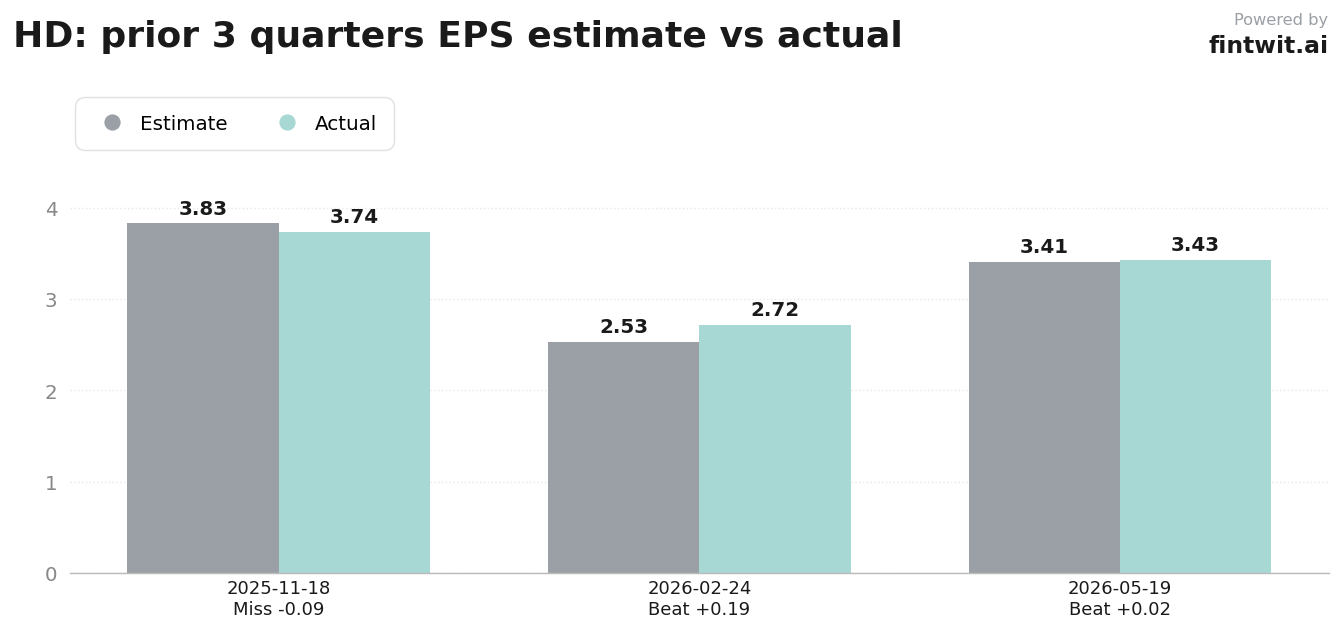
Home Depot has shown a consistent ability to outperform estimates over the last three quarters, as detailed in the historical data provided.
- EPS Estimate: $4.73
- Revenue Estimate: $47.27 billion
- Q1 2026 EPS: $3.43 (Estimate: $3.41)
- Q4 2026 EPS: $2.72 (Estimate: $2.53)
- Q3 2025 EPS: $3.74 (Estimate: $3.83)
What we'll watch on the call
The primary focus remains on the Pro business segment and its ability to capture a larger share of the $1.2 trillion home improvement market. Analysts are looking for evidence of revenue synergies following the integration of SRS Distribution, GMS, and Mingledorff's.
Large-ticket, discretionary project spending is the second major area of concern. Management must clarify if these transactions have stabilized or if consumers are strictly limiting spending to essential, need-based repairs.
- How is the company managing operations during CEO Ted Decker's temporary medical leave?
- Are there signs of stabilization in large-ticket, discretionary project spending?
- To what extent are recent acquisitions contributing to revenue synergies?
- Does the company still have confidence in its full-year guidance, or are macro headwinds forcing a reassessment?
Fintwit's AI verdict
The quantitative models suggest a favorable setup for the upcoming print, provided the company addresses the uncertainty surrounding its discretionary sales segments. While the macro environment remains a headwind, the historical performance of the company against analyst estimates provides a baseline for potential upside.
Investors should weigh the impact of the current leadership transition against the long-term potential of the Pro segment strategy. The market reaction will likely hinge on the credibility of the second-half recovery narrative presented by management.