The matchup
The home improvement industry is currently defined by a divergence in strategy between the two dominant players. The Home Depot has doubled down on its Pro-segment ecosystem, utilizing recent acquisitions like SRS and GMS to capture a larger share of professional contractor spending.
Lowe's is focusing on its Total Home strategy, aiming to improve operational efficiency through its Perpetual Productivity initiative. While both companies face macro headwinds, their approaches to capturing market share in a high-rate environment differ significantly.
- The Home Depot (HD) market cap stands at $329.43 billion.
- Lowe's (LOW) market cap is $116.73 billion.
- Both companies are managing margin pressure from acquisition integration and higher input costs.
- Professional contractor demand remains a critical battleground for both retailers.
Numbers side by side
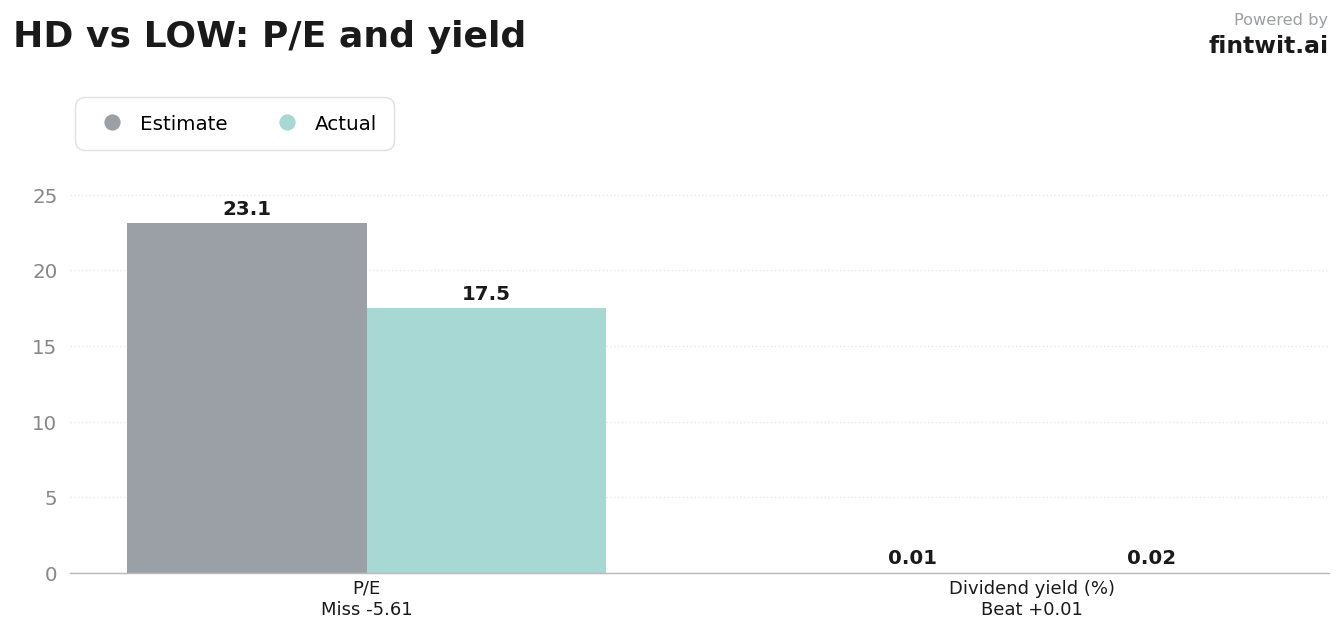
Valuation metrics highlight the premium investors are willing to pay for The Home Depot's scale and market dominance. Lowe's trades at a lower multiple, reflecting its current focus on internal productivity and cost-cutting measures.
Revenue growth figures for Q2 2026 show Lowe's outpacing The Home Depot, though this is balanced against higher debt loads from recent acquisitions.
- P/E Ratio: The Home Depot (23.09) vs. Lowe's (17.48).
- Dividend Yield: The Home Depot (1.41%) vs. Lowe's (2.35%).
- Revenue Growth (Q2 2026): The Home Depot (5.7% YoY) vs. Lowe's (8.3% YoY).
- 1-Year Price Performance: The Home Depot (-18.83%) vs. Lowe's (-19.38%).
- 90-Day Price Performance: The Home Depot (+4.11%) vs. Lowe's (-2.94%).
Bull and bear on each
Analysts remain divided on the near-term outlook for both retailers. The consensus reflects a cautious optimism regarding the Pro-channel execution for The Home Depot and the potential for margin recovery at Lowe's.
- HD Bull Case: Successful integration of SRS and GMS acquisitions driving long-term market share gains.
- HD Bull Case: Resilient demand for non-discretionary repair projects offsetting housing weakness.
- HD Bear Case: High sensitivity to interest rates due to heavy reliance on the professional contractor segment.
- HD Bear Case: Persistent weakness in big-ticket discretionary spending.
- LOW Bull Case: Execution of Total Home strategy driving consistent positive comparable sales.
- LOW Bull Case: Attractive dividend yield providing downside support for long-term investors.
- LOW Bear Case: Heightened debt load from acquisitions creating balance sheet pressure.
- LOW Bear Case: Risk of losing Pro-contractor share to specialized suppliers.
The verdict
The Home Depot continues to leverage its unmatched scale and deep integration with professional contractors to maintain its market position. Despite the current macro environment, the company's ability to navigate margin pressures remains a key differentiator for institutional investors.
Lowe's offers a compelling case for value-oriented investors, particularly given its lower valuation multiple and commitment to dividend growth. The success of its productivity initiatives will be the primary driver for future share price appreciation.