The setup
Market participants are shifting focus away from quarterly beat-and-raise cycles toward the magnitude of full-year guidance revisions. Investors are looking for confirmation that the incretin franchise, specifically Mounjaro and Zepbound, continues to outpace supply chain capacity.
Analyst sentiment remains volatile due to concerns regarding R&D charges and pricing dynamics. The primary debate centers on whether management will raise revenue guidance by $1 billion or more for the full year.
- Current 2026 revenue guidance sits at $82 billion to $85 billion.
- Non-GAAP EPS guidance is currently set at $35.50 to $37.00.
- Goldman Sachs analysts suggest a $1 billion revenue guidance raise is the key variable for stock performance.
- Bernstein analysts project a more aggressive guidance increase of at least $1.5 billion at the midpoint.
Consensus numbers
Consensus estimates for the second quarter reflect the high expectations placed on the company's metabolic and neuroscience portfolios. The following figures represent the current market expectations ahead of the August 5 release.
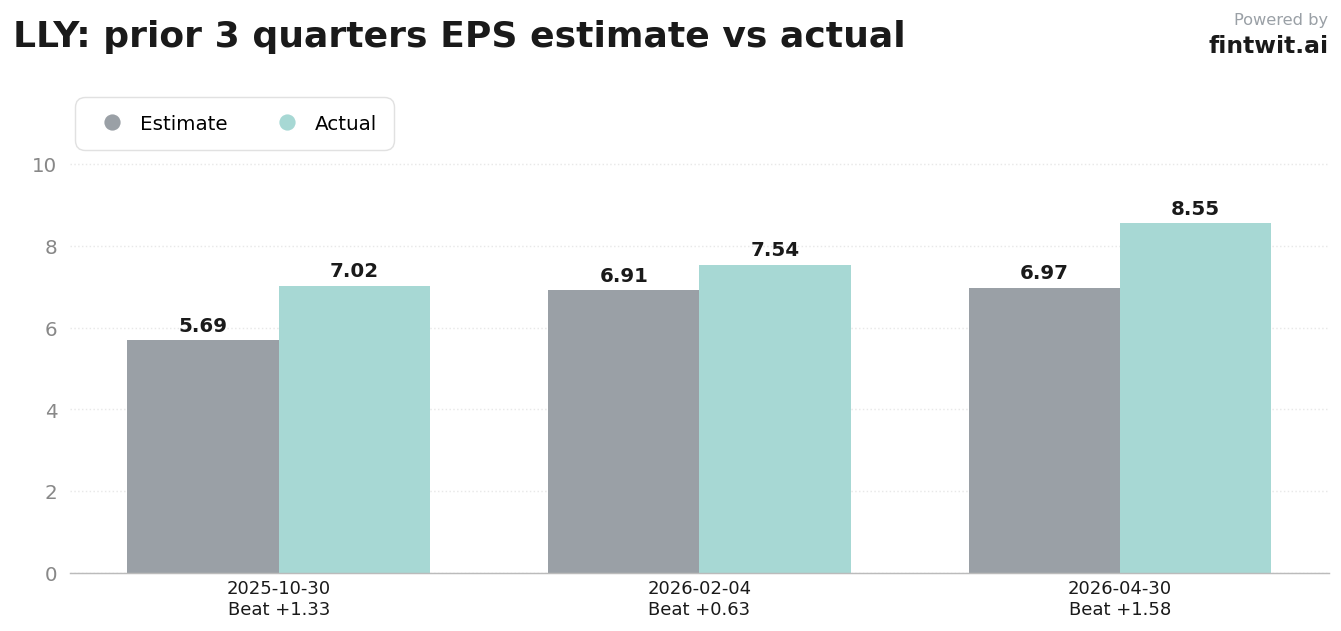
Eli Lilly has consistently outperformed revenue and EPS estimates over the last three quarters, as shown in the historical data.
- Consensus EPS estimate: $6.06.
- Consensus revenue estimate: $20.685 billion.
- Q1 2026 actual EPS: $8.55 vs $6.97 estimate.
- Q1 2026 actual revenue: $19.799 billion vs $17.818 billion estimate.
- Q4 2025 actual EPS: $7.54 vs $6.91 estimate.
- Q3 2025 actual EPS: $7.02 vs $5.69 estimate.
What we'll watch on the call
Management's commentary on manufacturing capacity will be the most critical component of the earnings call. Investors need to see evidence that the company can scale production to meet the sustained demand for its GLP-1 therapies.
The commercial trajectory of new product launches will also be under the microscope. Specifically, the market is looking for early data on the adoption of the oral GLP-1, Foundayo, and the rollout of Kisunla in the neuroscience segment.
- Manufacturing ramp-up status for Mounjaro and Zepbound to address supply constraints.
- Early payer and patient feedback regarding the launch of Foundayo.
- Management strategy for navigating US pricing reforms and potential access variability.
- Updated outlook for R&D and marketing expenditures following recent acquisition activity.
- Diagnostic bottlenecks and scan requirements impacting the initial Kisunla rollout.
Fintwit's AI verdict
The quantitative model suggests that the current market pricing for Eli Lilly reflects a high degree of confidence in the company's long-term growth trajectory. Despite macro headwinds and legislative pressure on drug pricing, the underlying demand for the metabolic portfolio remains a dominant force.
Investors should weigh the potential for a significant guidance raise against the risks of high valuation multiples and execution hurdles in the neuroscience division. The upcoming report will likely serve as a volatility catalyst for the broader healthcare sector.