
The setup
Deere enters the Q3 2026 print with a mixed outlook as the large-agriculture equipment cycle continues to show signs of cooling. Investors are focused on whether the company can maintain its historical margin resilience despite broader industry headwinds.
Management has maintained its fiscal 2026 net income guidance of $4.5 billion to $5.0 billion. This stance reflects a commitment to disciplined operations and continued investment in precision agriculture technology despite market volatility.
- JPMorgan maintains a Neutral rating with a price target of $570, citing concerns over order trends.
- DA Davidson holds a Buy rating with a $685 price target, citing confidence in long-term positioning.
- Market consensus remains a Moderate Buy with an average price target of $650.73.
- Macro headwinds include weakening North American demand for large tractors and combines.
- Customer purchasing decisions remain highly sensitive to commodity prices and interest rates.
Consensus numbers
Wall Street expects Deere to report earnings per share of $4.71 on revenue of $10.81 billion for the third quarter. The company has demonstrated a strong track record of exceeding expectations in previous quarters.
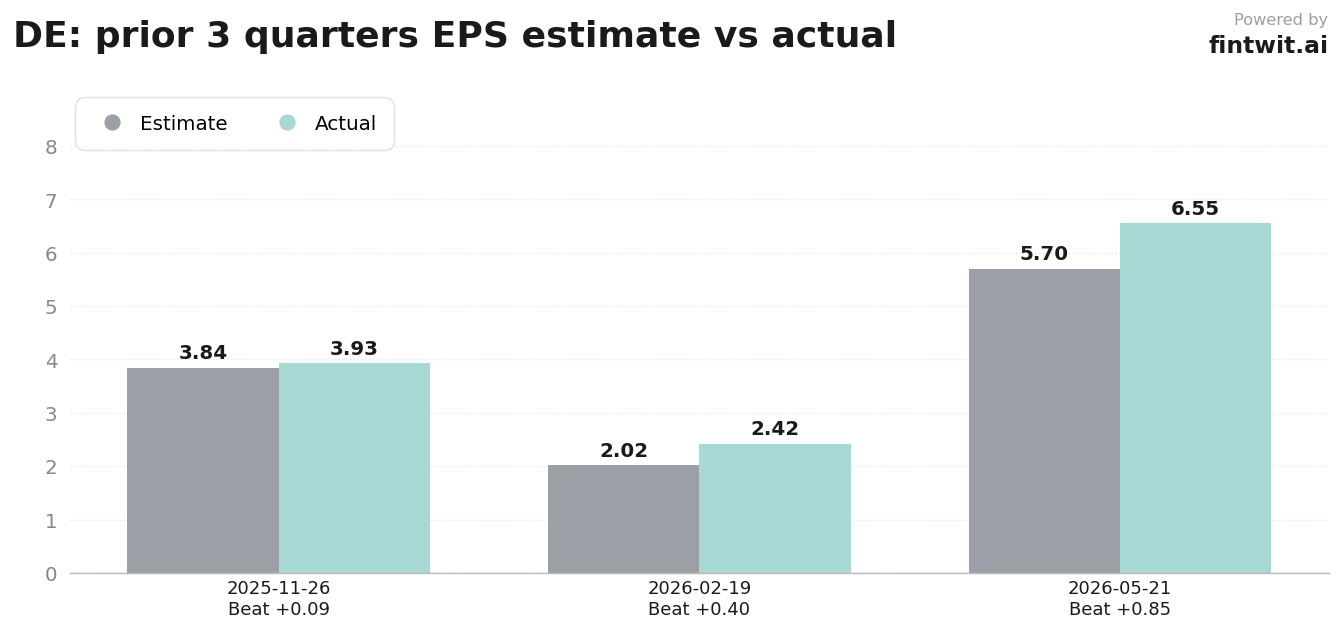
The following data highlights the recent performance history relative to consensus estimates. Investors should monitor if the current revenue estimate of $10.81 billion aligns with management's commentary on dealer inventory levels.
- EPS Estimate: $4.71
- Revenue Estimate: $10.81 billion
- Q2 2026 EPS: $6.55 (Beat vs $5.70 estimate)
- Q1 2026 EPS: $2.42 (Beat vs $2.02 estimate)
- Q4 2025 EPS: $3.93 (Beat vs $3.84 estimate)
- Beat Probability: 60% based on historical performance
What we'll watch on the call
The Production & Precision Agriculture segment remains the primary focus for analysts concerned about pricing aggression. Any sign of a year-over-year revenue decline in this core segment could trigger negative sentiment.
Construction & Forestry performance will be scrutinized to determine if volume growth is sustainable. Investors are looking for evidence that profit margins are not purely volume-driven.
- North American order trends for 2027 vs current expectations.
- Status of dealer inventory levels and signs of oversupply.
- Operating margin sustainability amid cost inflation and pricing pressure.
- Management's strategy for navigating the large-agriculture equipment downturn.
- Impact of recent adjustments to import tariffs on equipment pricing.
Fintwit's AI verdict
The quantitative model suggests that Deere's ability to navigate the current agricultural downturn is the primary driver for its valuation. While the stock has faced pressure from order concerns, the historical tendency to beat estimates provides a potential floor for the share price.
Investors should weigh the current market sentiment against the company's long-term technological moat in precision farming. The upcoming earnings call will be the definitive test of whether the current valuation is supported by fundamental operational efficiency.