
How we screened
We filtered the universe of large-cap equities to identify companies with a market capitalization exceeding 10 billion dollars and a P/E ratio below 6.00. This screen prioritizes immediate earnings yield over growth projections to isolate potential deep-value opportunities.
The resulting list highlights companies across energy, real estate, and telecommunications. We excluded firms with negative free cash flow to ensure the valuation floor is supported by actual cash generation.
- Market capitalization floor: 10 billion dollars.
- Valuation ceiling: 6.00 P/E ratio.
- Exclusion criteria: Negative free cash flow (TTM) and non-standard financial structures.
The list
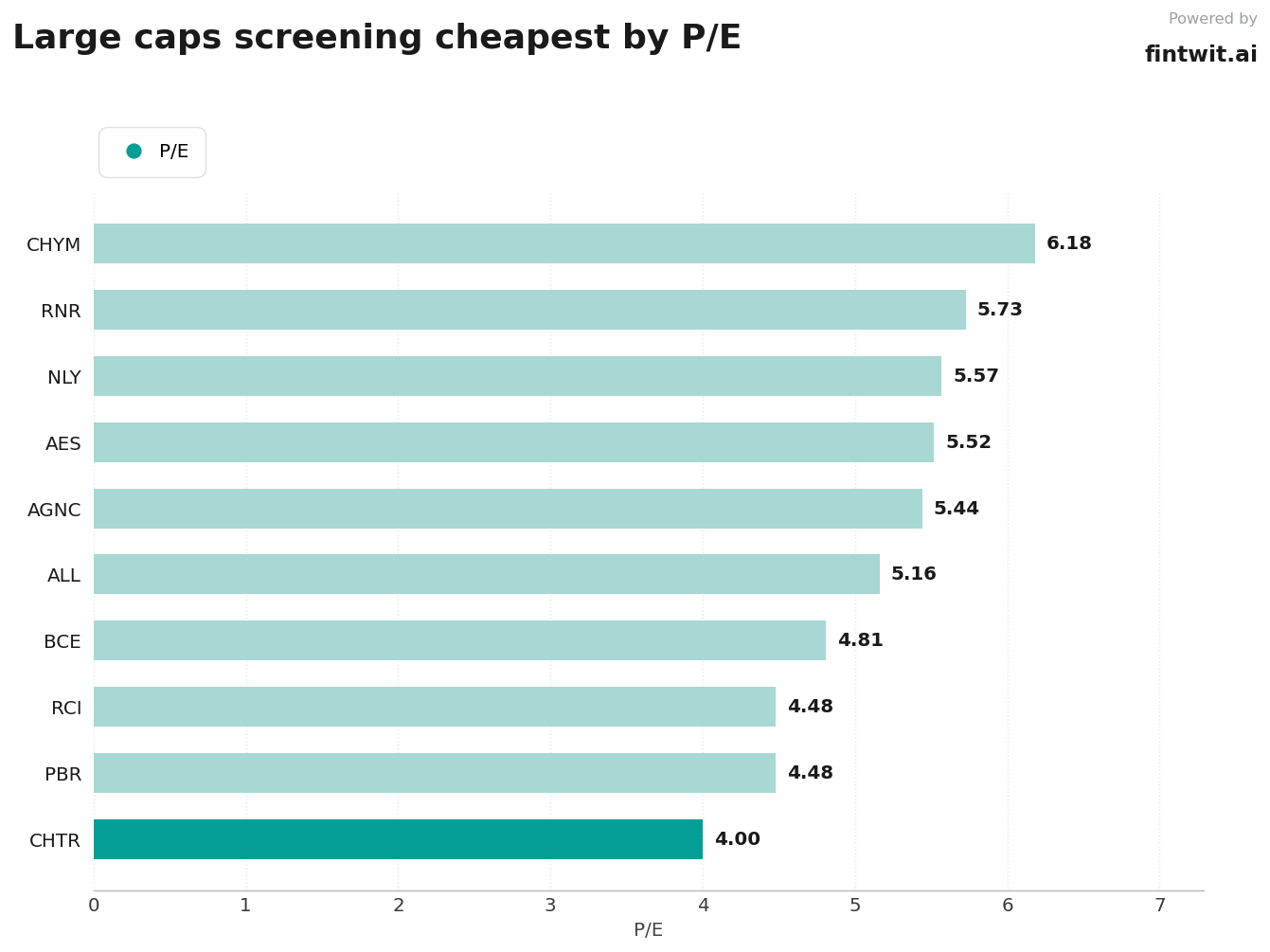
The following companies represent the lowest P/E multiples within our large-cap screen. Investors should note that low multiples often reflect market skepticism regarding future earnings stability or debt burdens.
- Charter Communications (CHTR): P/E 4.00. Valuation reflects high leverage and cord-cutting pressures. Analyst take: Market remains wary of long-term subscriber churn.
- Rogers Communications (RCI): P/E 4.48. Valuation reflects conglomerate discount and high debt. Analyst take: Seeking Alpha notes it is a value trap until the debt profile improves.
- Petroleo Brasileiro (PBR): P/E 4.48. Valuation reflects geopolitical risk and commodity price volatility. Analyst take: High dividend yield of 20.6% compensates for political uncertainty.
- BCE Inc (BCE): P/E 4.81. Valuation reflects high capital expenditure requirements. Analyst take: Dividend yield of 7.45% is the primary draw for income-focused investors.
- The Allstate Corporation (ALL): P/E 5.16. Valuation reflects property and casualty insurance cycle risks. Analyst take: Strong free cash flow yield of 21.6% supports current valuation.
- AGNC Investment Corp (AGNC): P/E 5.44. Valuation reflects interest rate sensitivity in mortgage REITs. Analyst take: High 13.3% dividend yield carries significant duration risk.
- Renaissancere Holdings (RNR): P/E 5.73. Valuation reflects catastrophe risk exposure. Analyst take: Exceptional free cash flow yield of 30.76% highlights underwriting efficiency.
Caveats
A low P/E ratio is not a guarantee of future performance and frequently serves as a warning sign of structural decline. Investors must distinguish between temporary market mispricing and permanent impairment of the underlying business model.
- Debt-to-equity ratios for telecom firms like RCI and CHTR remain elevated, limiting capital allocation flexibility.
- Energy and commodity-linked stocks like PBR are subject to cyclical downturns that can rapidly expand P/E ratios if earnings contract.
- Dividend yields exceeding 10% in REITs like AGNC often indicate market expectations of future payout cuts.
- Free cash flow yield is a superior metric to P/E for capital-intensive industries like utilities and telecom.
How to use this screen
Use this list as a starting point for fundamental analysis rather than a buy list. The primary objective is to identify companies where the market has priced in a worst-case scenario that may not materialize.
Focus on the free cash flow yield column to determine if the earnings are backed by cash. If a company has a low P/E but negative free cash flow, it is likely a liquidity risk rather than a value opportunity.
- Compare the P/E ratio against the company's five-year historical average to determine if the current discount is anomalous.
- Analyze the PEG ratio to see if the low valuation is justified by a lack of growth.
- Review the most recent 10-Q filing to confirm debt maturity schedules for companies with high leverage.