
How we screened
We filtered the current market for large-cap equities with P/E ratios below 8.0 to identify potential value traps versus mispriced assets.
The screen focuses on companies with significant free cash flow generation, as this metric often provides a buffer against temporary valuation compression.
We categorized each stock's discount as either earned, where fundamental risks justify the low multiple, or unearned, where market sentiment appears disconnected from operational reality.
The list
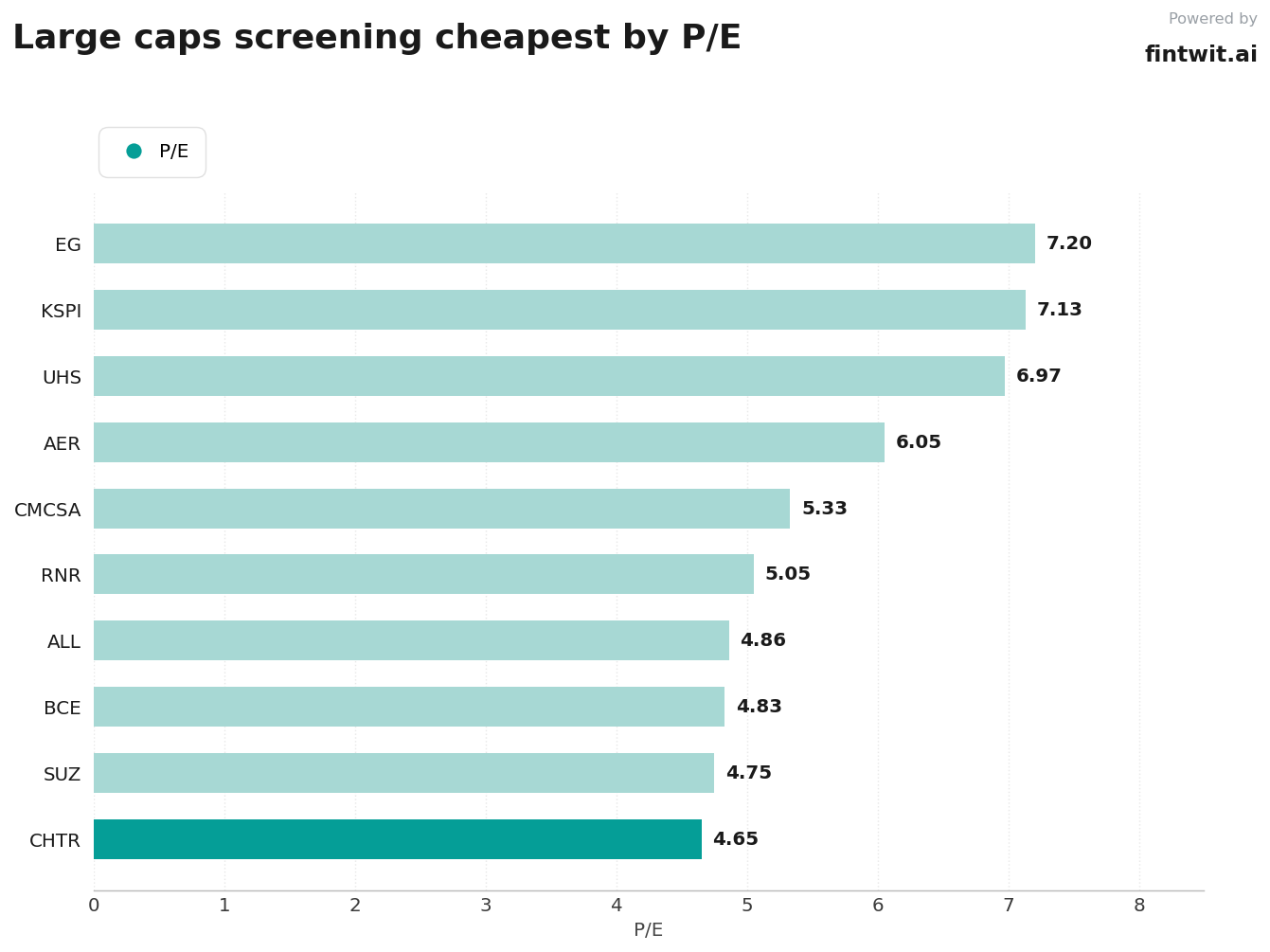
The following tickers represent a cross-section of industries currently facing valuation pressure according to our screen.
See chart screen-pe for a visual comparison of these P/E multiples.
- CHTR (P/E 4.65): Fundamental headwinds like subscriber attrition justify the discount until stabilization occurs; analyst view: the discount reflects an overly pessimistic view of long-term earnings power.
- SUZ (P/E 4.75): Market sentiment is focused on cyclical commodity lows rather than improved capital position; analyst view: 2026 will see lower CapEx and limited downside.
- BCE (P/E 4.83): Discount driven by short-term fear of Starlink disruption; analyst view: recent share price volatility is a short-term issue.
- ALL (P/E 4.86): Strong underwriting performance suggests the market is overly cautious on catastrophe risk; analyst view: investors are ignoring potential for capital returns.
- RNR (P/E 5.05): Discount reflects legitimate uncertainty regarding future catastrophe loss cycles; analyst view: path depends on whether reinsurance capacity remains disciplined.
- CMCSA (P/E 5.33): Market is overly pessimistic regarding broadband losses; analyst view: the valuation implies a massive discount that is hard to justify under rational assumptions.
- AER (P/E 6.05): Fundamentals remain strong despite sector rotation into AI; analyst view: pressures stem from sentiment rather than operational failure.
- UHS (P/E 6.97): Discount is earned due to tangible policy-driven risks; analyst view: Medicaid reimbursement changes are a significant headwind for profitability.
- KSPI (P/E 7.13): Business fundamentals are exceptional; analyst view: the stock is priced into the toilet based on geopolitical concerns.
- EG (P/E 7.20): Discount is earned as the market prices in a softening insurance pricing environment; analyst view: heavier catastrophe exposure could pressure margins.
Caveats
Low P/E ratios are often a signal of structural decline rather than a bargain, particularly in the telecom and commodity sectors.
Investors must distinguish between companies with permanent impairment and those facing temporary cyclical downturns.
Geopolitical and regulatory risks can keep multiples depressed for extended periods, regardless of underlying cash flow strength.
- Free cash flow yield can be misleading if the company is liquidating assets or deferring necessary maintenance CapEx.
- High dividend yields, such as BCE's 9.64%, may signal market doubt regarding the sustainability of the payout.
- Reinsurance stocks like RNR and EG are highly sensitive to unpredictable catastrophe events that can wipe out annual earnings in a single quarter.
How to use this screen
Use this list as a starting point for fundamental due diligence rather than a buy list.
Compare the free cash flow yield against the P/E ratio to see if the earnings quality supports the current valuation.
Monitor the specific catalysts mentioned for each ticker to determine if the market's thesis is beginning to shift.