
The setup
BJ's Wholesale Club continues to navigate a complex retail environment defined by persistent inflation and shifting consumer priorities. The company's ability to maintain its value proposition against larger competitors like Costco and Sam's Club remains the primary focus for institutional investors.
Management has maintained its fiscal 2026 guidance, targeting comparable club sales growth of 2.0% to 3.0% excluding gasoline. This outlook reflects a commitment to disciplined cost management and strategic pricing investments designed to widen the price gap against conventional grocery and retail competitors.
- UBS maintains a Buy rating with a $109 price target, citing strong value proposition.
- DA Davidson maintains a Buy rating but lowered its price target to $105 due to margin concerns.
- Zacks Investment Research identifies the company as a potential candidate for an earnings beat based on current momentum.
- Macro headwinds include persistent inflation impacting discretionary spending and intense competition in the warehouse sector.
Consensus numbers
Wall Street expects a steady performance for the second quarter of 2026. The consensus estimate for earnings per share sits at $1.17, while revenue is projected at $5.97 billion.
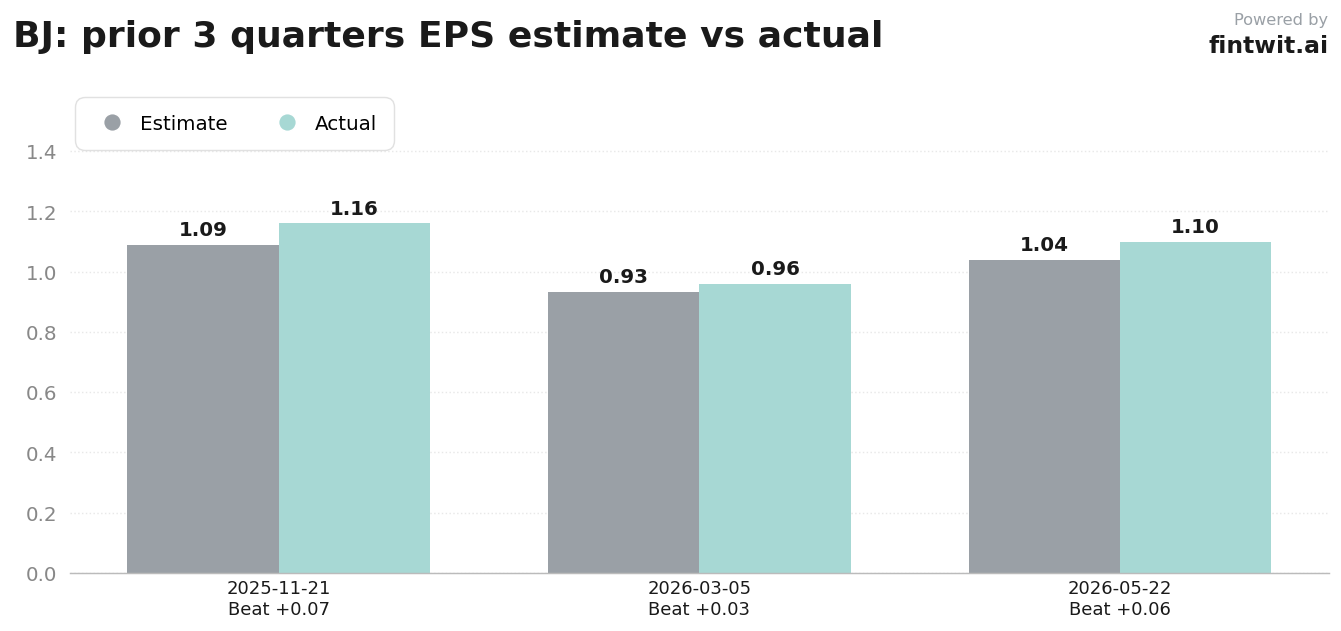
The company has demonstrated a consistent ability to outperform analyst expectations in recent quarters, as shown in the historical data below.
- Q2 2026 EPS Estimate: $1.17
- Q2 2026 Revenue Estimate: $5.97 billion
- Q1 2026 Actual EPS: $1.10 (vs $1.04 estimate)
- Q4 2025 Actual EPS: $1.16 (vs $1.09 estimate)
- Q3 2025 Actual EPS: $0.96 (vs $0.93 estimate)
What we'll watch on the call
Investors are looking for granular details on how the company is managing its membership base and inventory mix. The effectiveness of the club's value proposition is best captured through membership fee income and fresh food performance.
The company's expansion strategy, particularly in the Texas market, will be a key indicator of long-term growth potential. Management's commentary on tariff-related cost mitigation will also be critical for understanding future margin stability.
- Performance of new store openings in the Texas market relative to internal expectations.
- Sustainability of membership fee income as a recurring revenue stream.
- Trends in discretionary spending categories like consumer electronics versus essential fresh foods.
- Utilization of tariff refunds to maintain competitive pricing gaps.
- Impact of fuel price fluctuations on overall store traffic and member engagement.
Fintwit's AI verdict
The current market sentiment surrounding BJ's Wholesale Club reflects a cautious optimism regarding its defensive positioning. While the company has historically proven its ability to navigate inflationary cycles, the upcoming earnings report will test whether it can sustain its current momentum in the face of tightening consumer budgets.
Investors should monitor the balance between aggressive pricing strategies and the protection of operating margins. The path forward remains contingent on the company's ability to convert traffic into long-term membership loyalty.