The setup
Barrick Mining Corporation (B) is navigating a period of significant operational transition as it attempts to balance its core gold assets with a strategic pivot toward copper. Management has maintained its full-year 2026 gold production guidance of 2.90 to 3.25 million ounces.
The company continues to operate under the assumption of a $4,500/oz gold price environment. However, inflationary pressures on energy and fuel remain the primary headwinds for maintaining margins.
Analysts from Scotiabank, RBC Capital Markets, and Bank of America have adjusted their outlooks ahead of the print. The consensus remains cautious regarding the company's ability to offset sequential production challenges.
- Scotiabank analyst T. Jakusconek maintains a Sector Outperform rating with a $57.00 price target.
- RBC Capital Markets analyst Josh Wolfson holds a $49.00 price target, citing tough sequential comparisons.
- Bank of America maintains a Buy rating with a $56.00 price target, noting valuation concerns.
- Geopolitical risks in Mali and Pakistan remain key variables for operational continuity.
Consensus numbers
Market expectations for the second quarter of 2026 reflect a cautious optimism tempered by rising input costs. The consensus EPS estimate stands at $0.81, while revenue is projected to fall between $4.49 billion and $5.10 billion.
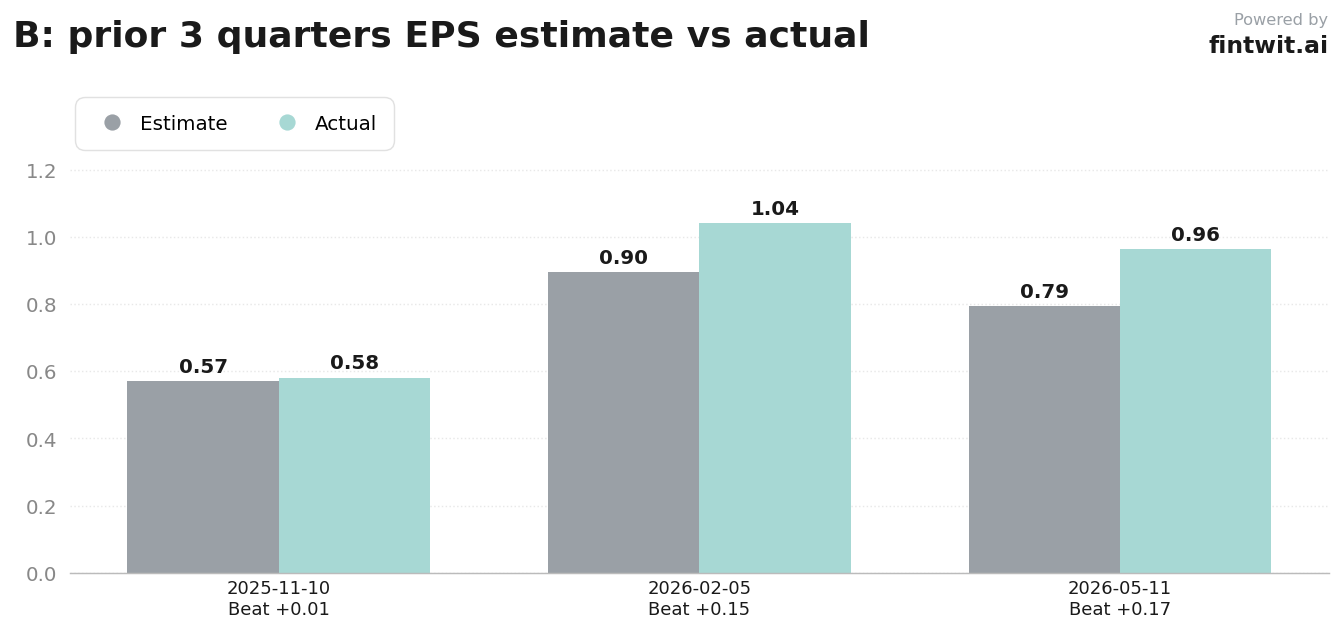
The company has shown volatility in its recent earnings surprises, as detailed in the historical data. Investors are looking for consistency in margin management across its primary mining segments.
The following data points summarize the current consensus and recent performance history.
- Consensus EPS estimate: $0.81.
- Revenue estimate range: $4.49 billion to $5.10 billion.
- Q1 2026 actual EPS: $0.963 vs $0.794 estimated.
- Q4 2025 actual EPS: $0.58 vs $0.57 estimated.
- Q1 2026 actual revenue: $4.11 billion vs $4.75 billion estimated.
- Beat probability: 45%; Miss probability: 35%; Inline probability: 20%.
What we'll watch on the call
Management's commentary on All-In Sustaining Costs (AISC) will be the most scrutinized metric during the earnings call. Analysts are looking for evidence that the company can keep AISC within the $1,760 to $1,950 per ounce range despite inflationary pressures.
The strategic pivot toward copper remains a central theme for long-term growth. Performance at the Lumwana asset is critical for proving the viability of this diversification strategy.
Capital allocation remains a top priority for shareholders. Questions regarding the Reko Diq project timeline and the potential North American IPO of gold assets are expected to dominate the Q&A session.
- AISC management: How are energy and fuel costs impacting the $1,760–$1,950 range?
- Reko Diq project: What is the latest capital expenditure outlook and timeline?
- North American IPO: Is there a concrete update on the timeline for spinning off gold assets?
- Production sequencing: Are Nevada and Pueblo Viejo assets meeting ramp-up targets?
- Geopolitical impact: How are operations in Mali and Pakistan currently being mitigated?
Fintwit's AI verdict
The current market sentiment surrounding Barrick Mining reflects a divergence between the company's strong production capacity and the macroeconomic risks inherent in the mining sector. While the gold price environment provides a tailwind, the operational execution in high-risk jurisdictions remains the primary point of contention for institutional investors.
As the August 10 report approaches, the focus shifts to whether the company can deliver on its capital allocation promises without sacrificing its balance sheet strength. The market is positioned for a potential move based on how management addresses the Reko Diq expenditure and the North American IPO strategy.