
The setup
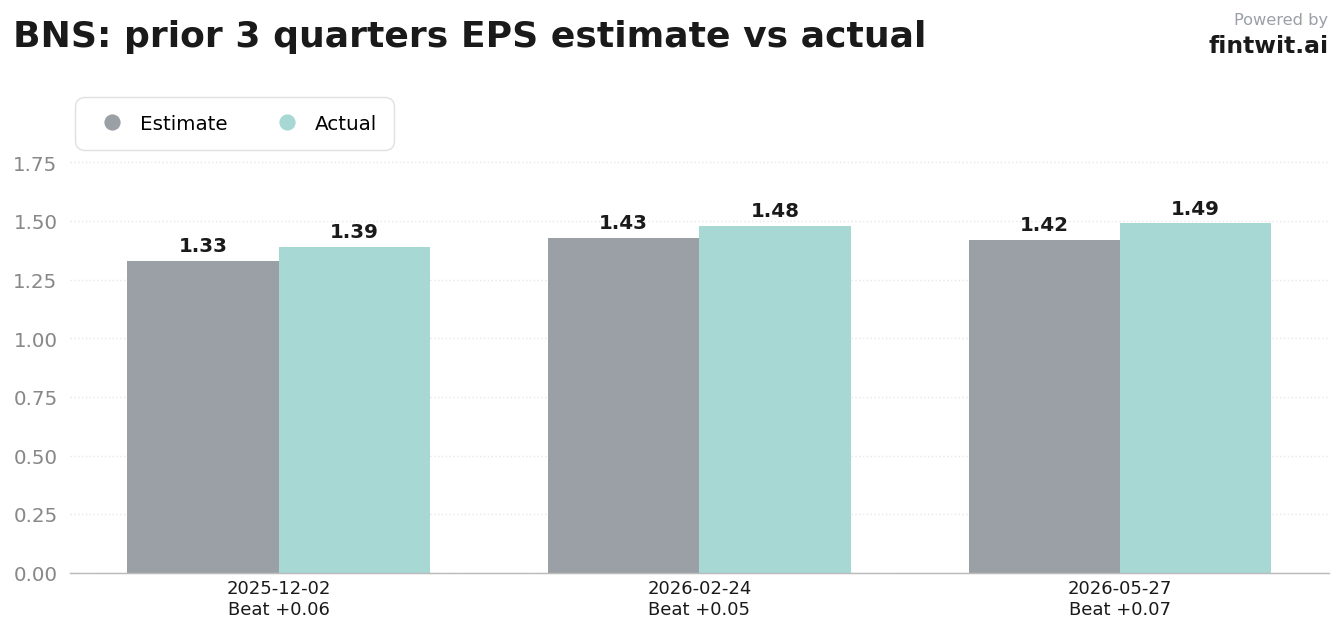
Bank of Nova Scotia (BNS) faces a critical test on August 25 as it navigates a complex macroeconomic environment defined by interest rate uncertainty and shifting credit conditions. The bank has maintained a consistent record of exceeding analyst expectations over the past year, providing a buffer against recent market volatility.
Management continues to prioritize its fiscal 2026 strategic objectives, including the implementation of Scotia Intelligence to drive operational efficiency. The bank remains committed to its long-term target of achieving a 14% return on equity by fiscal 2027.
- Market capitalization stands at approximately $106.9 billion.
- Royal Bank of Canada recently raised its price target for BNS from $98.00 to $117.00.
- Jefferies maintains a Hold rating, reflecting caution despite recent earnings momentum.
- The broader market consensus remains a Hold as investors evaluate the bank's premium valuation.
Consensus numbers
Analysts are currently modeling an EPS of $1.53 for the third quarter of 2026. Revenue estimates are pegged at approximately $7.09 billion.
The bank's performance in its core segments will be the primary driver of whether it sustains its recent earnings streak. Investors are particularly focused on the delta between these estimates and the actual results reported on August 25.
- EPS Estimate: $1.53.
- Revenue Estimate: $7.09 billion.
- Canadian Banking: Analysts look for sustained margin expansion following a 53% YoY earnings jump in Q2 2026.
- International Banking: Performance in Pacific Alliance countries remains a key differentiator for revenue growth.
- Global Wealth Management: Fee income growth from rising AUM is expected to offset potential softness in other divisions.
- Beat History: The bank has outperformed consensus estimates for four consecutive quarters.
What we'll watch on the call
The earnings call will likely focus on the bank's ability to manage net interest margins in the face of an unpredictable Bank of Canada policy path. Credit quality remains a secondary, yet equally vital, area of concern for institutional investors.
Management's commentary on capital allocation will be scrutinized for any shifts in dividend policy or share buyback programs. The integration of AI-driven efficiency initiatives will also be a focal point for analysts assessing long-term margin expansion.
- Net Interest Margins: How are margins trending given current interest rate volatility?
- Credit Loss Provisions: What is the outlook for impaired PCL ratios, specifically regarding commercial real estate and consumer lending?
- Efficiency Gains: Can management provide concrete data on the long-term impact of the Scotia Intelligence rollout?
- Capital Allocation: Are there updates regarding dividend growth or share repurchase plans?
- Macro Headwinds: How are trade uncertainties and energy price volatility impacting the bank's risk profile?
Fintwit's AI verdict
The quantitative models suggest a favorable outlook for the upcoming print, driven by the bank's historical ability to navigate interest rate cycles and maintain operational discipline. While the valuation is currently at a premium, the underlying momentum in the Canadian and International banking segments provides a compelling narrative for those looking at the long-term trajectory.
Investors should weigh the potential for continued earnings surprises against the broader macroeconomic risks that could pressure the entire financial sector. The data points toward a specific strategic direction that aligns with the bank's stated fiscal 2027 goals.