
The setup
BMO currently holds a market capitalization of $121.1 billion. The bank faces a complex macroeconomic environment characterized by shifting central bank interest rate expectations and persistent inflationary pressures.
Management has prioritized disciplined expense management and cost optimization throughout 2026. The firm is navigating a delicate balance between maintaining credit quality and pursuing growth in the U.S. market.
- MarketBeat consensus maintains a Hold rating with a price target of $163.00.
- Simply Wall St estimates a fair value of $233.68, highlighting a divergence between market price and fundamental models.
- Harsh Kumar of BMO Capital Markets remains bullish on AI-linked growth strategies.
- The bank is managing volatility through a focus on digital and AI-driven efficiency gains.
Consensus numbers
Analysts expect BMO to report earnings per share of $2.66 for the third quarter of 2026. Revenue is projected to reach $6.93 billion.
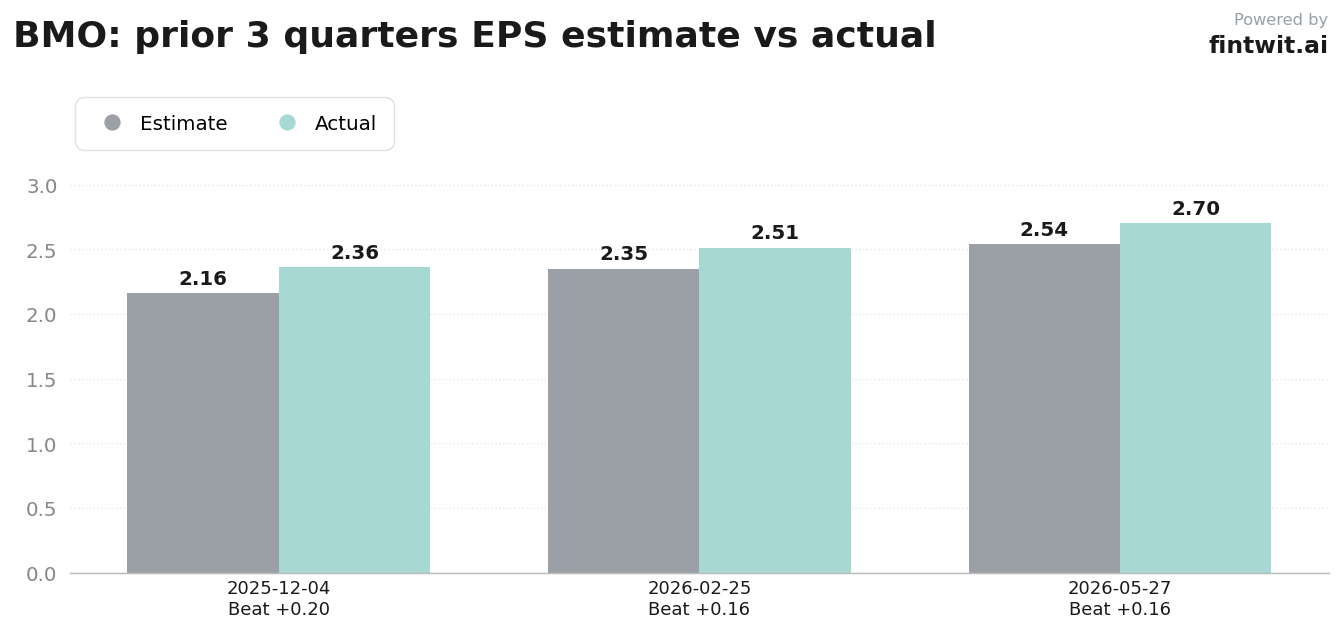
The bank has demonstrated consistent performance, beating estimates in each of the last three reported quarters. The following data details the recent history of earnings surprises.
Market participants are closely watching the U.S. Personal and Commercial Banking segment for evidence of successful cost synergy integration.
- Q3 2026 EPS Estimate: $2.66
- Q3 2026 Revenue Estimate: $6.93 billion
- Q2 2026 Actual EPS: $2.70 (vs $2.54 estimate)
- Q1 2026 Actual EPS: $2.51 (vs $2.35 estimate)
- Q4 2025 Actual EPS: $2.36 (vs $2.16 estimate)
- Beat Probability: 65% beat, 15% miss, 20% inline
What we'll watch on the call
Management commentary regarding credit provisions will be the primary focus for institutional investors. The health of the Canadian and U.S. consumer remains a critical variable for loan loss reserves.
Net interest margin (NIM) trends will be scrutinized to determine how the bank is adapting to the current interest rate cycle. Analysts will look for specific details on how loan demand is holding up against higher borrowing costs.
- Credit provision trends relative to unemployment rates in core markets.
- NIM trajectory in the context of shifting central bank easing cycles.
- Operational cost-control metrics and progress on digital transformation investments.
- Capital Markets segment performance and client activity levels during the quarter.
- Impact of geopolitical and inflationary pressures on operational overhead.
Fintwit's AI verdict
The quantitative models suggest that BMO is positioned to capitalize on its current operational momentum. While valuation concerns persist among some analysts, the bank's track record of exceeding expectations provides a compelling narrative for those focused on execution.
Investors should monitor the upcoming report for signs of margin expansion and disciplined credit management. The data indicates a favorable outlook for the firm as it navigates the current economic cycle.