The matchup
Apple relies on its 2.2 billion active device ecosystem to drive high-margin services revenue. The company is currently betting on a new hardware upgrade supercycle to prove its generative AI capabilities.
Microsoft centers its strategy on enterprise integration through Azure and the M365 Copilot suite. The firm is aggressively scaling its AI infrastructure, which currently generates a $37 billion annual run rate.
- Apple's moat is built on hardware-software integration and premium brand pricing power.
- Microsoft's moat is defined by high switching costs in enterprise software and cloud dominance.
- Apple faces regulatory scrutiny regarding App Store economics.
- Microsoft faces margin pressure from massive capital expenditures required for AI data centers.
Numbers side by side
Valuation and growth metrics highlight distinct paths for both companies. Microsoft is growing revenue at 18% year-over-year, while Apple reports 16% growth as of Q3 2026.
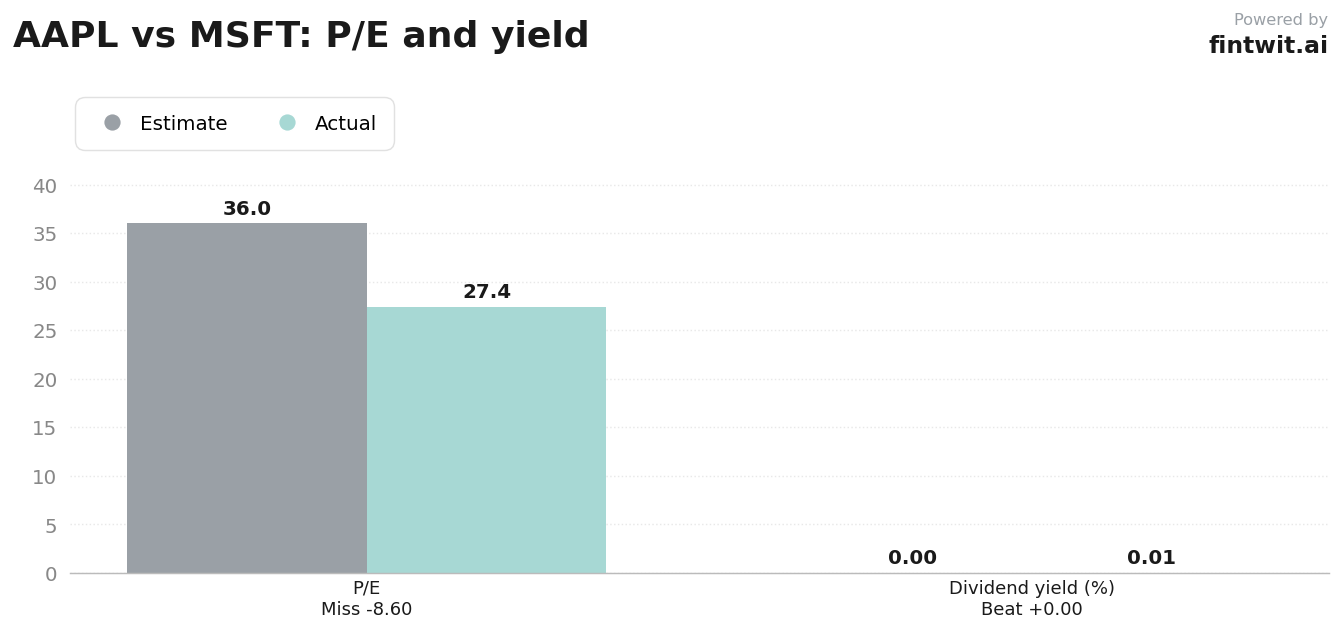
The P/E ratios reflect investor sentiment toward their respective AI strategies. Microsoft trades at a 27.39x multiple, compared to Apple's 35.99x.
- Market Cap: Apple $4.57T vs. Microsoft $3.68T.
- P/E Ratio: Apple 35.99 vs. Microsoft 27.39.
- Revenue Growth: Apple 16% YoY vs. Microsoft 18% YoY.
- Dividend Yield: Apple 0.34% vs. Microsoft 0.74%.
- 1-Year Performance: Apple +35.27% vs. Microsoft -0.90%.
Bull and bear on each
Analysts remain divided on the execution of AI strategies for both firms. Bank of America analyst Wamsi Mohan remains bullish on Apple's potential for capital deployment, while LightShed Partners' Walter Piecyk expresses skepticism regarding Siri's competitive positioning.
Microsoft's leadership, including CFO Amy Hood, maintains confidence in long-term cloud growth. Conversely, independent analyst Charles Fitzgerald warns of the transition of AI costs from CapEx to OpEx.
- AAPL Bull: AI-integrated hardware drives a massive upgrade supercycle.
- AAPL Bull: Services segment provides stable, high-margin recurring revenue.
- AAPL Bear: Regulatory pressure on App Store economics threatens margins.
- AAPL Bear: Perceived lag in generative AI capabilities compared to peers.
- MSFT Bull: Azure and AI services scaling at a $37B+ annual run rate.
- MSFT Bull: Strong enterprise trust ensures long-term monetization of AI tools.
- MSFT Bear: Massive AI-related capital expenditures pressure free cash flow.
- MSFT Bear: Regulatory scrutiny regarding market dominance and OpenAI dependency.
The verdict
The choice between these two giants depends on your tolerance for infrastructure-heavy growth versus consumer-focused ecosystem stability. Microsoft offers a more direct path to AI monetization, whereas Apple's success hinges on consumer adoption of new hardware features.